The 7 most common myths about microcurrent therapy
Microcurrent and frequency-specific microcurrent therapy (FSM) have become firmly established in many practices in recent years. At the same time, when speaking with therapists, doctors and alternative practitioners, one repeatedly encounters similar reservations and misunderstandings. Some of these stem from experiences with conventional electrotherapy, whilst others arise from unclear communication, exaggerated claims and incomplete information.
This article addresses the seven most common myths surrounding microcurrent and FSM, analysing them objectively, practically and without exaggeration. The aim is to provide clarity, to help contextualise the method more effectively and to lay the groundwork for its considered use in everyday clinical practice.
Myth 1: “Microcurrent is just another form of stimulation current.”
At first glance, microcurrent appears to many to be a variant of the familiar electrical stimulation methods: a device, cables, electrodes – in other words, ‘electricity applied to the patient’. From this perspective, microcurrent is quickly lumped together with TENS or conventional electrotherapy.
In fact, however, microcurrent differs in one key respect: the dose.
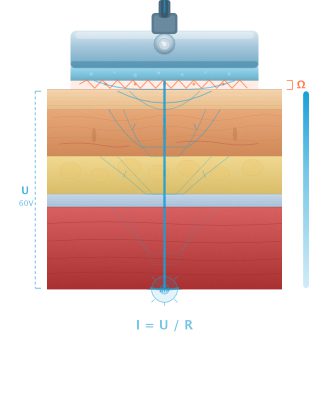
Whilst traditional electrical stimulation methods operate at current levels that are clearly perceptible and often trigger muscle contractions, microcurrent operates in the microampere range – that is, well below the threshold of perception.
This also shifts the therapeutic approach.
The focus is not on the perceptible stimulation of muscles or nerves, but on influencing regulatory processes at the cellular and tissue levels. Experimental studies have, for example, investigated the extent to which microcurrent can influence ATP production, membrane potentials and tissue regulation.
In everyday clinical practice, this means that microcurrent is not ‘stimulation current 2.0’, but a distinct therapeutic approach with its own dosage logic and objectives. It should be understood as an additional pillar within the therapeutic concept and not simply as a variant of conventional electrotherapy.
Myth 2: ‘If the patient doesn’t feel anything, nothing is happening.’
Many patients are used to a treatment being ‘noticeable’ – be it through pressure, stretching, heat, cold or an electric tingling sensation. If this sensation is absent, the impression quickly arises that nothing is happening.
With microcurrent therapy, the exact opposite is intended:
The current strength is set so that it is generally not felt. The lack of sensation is therefore not a sign of ineffectiveness, but a characteristic of the method.
This presents the therapist with a communication challenge. It helps to explain from the outset that microcurrent operates within the physiological range where the patient feels little or nothing. What matters is not the effects felt during the treatment, but the changes observed over time:
-
Range of motion
-
Tissue tension
-
Swelling
-
Pain reports
-
Functional tests
Anyone who consistently links microcurrent therapy to such observation parameters and documents them shifts the discussion from ‘I can’t feel anything’ to ‘What has changed over the course of several sessions?’. It is therefore more a matter of managing expectations and assessing progress than a question of fundamental effectiveness.
Myth 3: ‘Microcurrent therapy is only suitable for acute sports injuries.’
Many colleagues first become familiar with microcurrent in the context of sports medicine: sprains, muscle fibre tears, bruises, post-operative swelling. This easily leads to the perception that ‘microcurrent is an acute treatment for athletes’.
In fact, microcurrent is used much more widely in clinical practice – always as a component of a multimodal approach and following careful assessment of the indication. Examples include, amongst others:
-
chronic pain syndromes with neuropathic or myofascial components
-
muscular imbalances and issues with muscle chains
-
lymphatic issues such as oedema and impaired drainage
-
functional respiratory disorders involving the diaphragm
It is important to note that microcurrent does not replace diagnostic procedures or other measures crucial to treatment. It can complement existing treatment plans by targeting regulatory processes that play a role in many chronic conditions. Anyone who associates microcurrent exclusively with acute sports injuries overlooks potential areas of application in broader day-to-day clinical practice.
Myth 4: “FSM is esoteric; frequencies are just chosen at random.”
FSM, or frequency-specific microcurrent therapy, is a constant source of confusion. Viewed from the outside, one sees various frequencies, terms such as ‘conditions’ and ‘tissues’, and complex protocols – to outsiders, this can quickly appear arbitrary or ‘chosen at a whim’.
However, FSM is based on a structured approach:
Specific frequencies are linked to specific conditions and tissues. The aim is to take into account both the pathophysiology of the clinical picture and the structures involved. The protocols do not arise from spontaneous inspiration, but from systematic work with documented frequency combinations, clinical experience and, in some cases, published case series and studies.
Of course – as with any form of therapy – there are varying levels of quality in its application. What matters is how the individual practitioner approaches it:
-
Is the clinical presentation analysed thoroughly?
-
Is there a clear rationale for the choice of frequencies?
-
Are the course of treatment and reactions documented?
-
Is the whole process embedded within a sound overall approach?
FSM is not a belief system, but a tool. Whether it appears credible depends largely on whether it is combined with an understanding of pathophysiology, documentation and realistic communication.
Myth 5: ‘Microcurrent is a legal grey area.’
Uncertainties surrounding the law, liability and regulations are a sensitive issue in many practices. Bad experiences with unclear devices or exaggerated advertising contribute to microcurrent being perceived across the board as a ‘grey area’.
It is worth taking a more nuanced view here:
A medical microcurrent system is, first and foremost, a medical device. This entails clear requirements – ranging from conformity assessment and technical documentation to quality processes at the manufacturer’s premises.
On the user’s side, the following apply, amongst other things:
-
Operators’ obligations
-
Appropriate induction and training
-
Documentation obligations
-
compliance with the Medicines Advertising Act in external communications
Microcurrent is therefore not automatically a legal grey area. Problems arise primarily where:
-
devices are used without a clear medical purpose
-
Documentation and instruction are lacking
-
advertising claims are made that are not compatible with statutory requirements
On the other hand, anyone who uses an approved, comprehensively documented system, provides patients with factual information, makes no claims of a curative nature and integrates microcurrent into existing quality management structures is operating on a much more stable footing.
Myth 6: “It’s all far too complicated for day-to-day practice.”
Particularly in busy practices, this reaction is understandable: “Yet another method, yet another device, even more organisation – there’s no room for that in my day.”
Microcurrent becomes complex, above all, when one tries to implement everything at once. A step-by-step approach is far more practical:
-
Selecting one or two typical clinical presentations where microcurrent fits well into the existing treatment plan.
-
Work with clearly defined, simple standard protocols, rather than attempting to utilise the full range straight away.
-
Structured documentation of time spent, progress and responses over several weeks.
With this approach, a routine gradually develops. Microcurrent does not become an ‘additional burden’, but rather an integral part of defined procedures. Many practices report that certain cases actually become easier to plan as a result, because treatment regimens are more clearly structured.
Of course, there is still a learning curve: understanding the device, knowing the parameters, and being aware of contraindications. But this effort is inherent in any new method. The key is the conscious integration into existing processes – then microcurrent need not be complicated.
Myth 7: ‘There isn’t any reliable data on microcurrent.’
This myth is encountered particularly amongst scientifically minded colleagues. Often, it stems from the legitimate question regarding evidence and the state of research.
The truth is: the volume of data on microcurrent is not comparable to that of large-scale programmes involving established standard procedures or pharmaceutical trials. However, to conclude from this that there is ‘no reliable data at all’ is an oversimplification.
There are:
-
experimental studies
-
case series
-
clinical trials
-
and numerous documented case reports
which deal with various aspects of microcurrent therapy – such as pain, inflammation, wound healing or functional parameters.
What matters is not so much the sheer number of studies, but how they are interpreted:
-
What question does a study actually answer?
-
How comparable are the patient group and setting to one’s own practice?
-
How can the results be combined with your own experiences and patient feedback?
-
How should this be communicated to patients – in the form of advice and observations, not as guarantees?
Microcurrent therapy is a field in which further research is needed. The existing evidence allows for an objective assessment, but does not replace the need for critical analysis and clinical experience.
Conclusion: Microcurrent and FSM – between scepticism and potential
The seven myths illustrate why microcurrent and FSM are often the subject of controversy: outdated perceptions of stimulation current, a lack of perceptible effects, uncertainties regarding indications, legal issues and the state of the research. At the same time, opportunities are emerging for how the method can be applied sensibly, in a structured manner and responsibly.
In summary:
-
Microcurrent is a distinct approach in the microampere range and should be understood as a regulatory component within a therapeutic concept.
-
The patient’s lack of perception is normal; what is crucial are documented changes over time.
-
The range of applications extends beyond acute sports injuries, always within the framework of a clear, multimodal approach.
-
FSM can be understood as a structured, frequency-specific method – provided it is linked to pathophysiological knowledge and systematic documentation.
-
From a legal perspective, what matters is the quality of the system, the operator’s obligations and transparent communication, not blanket prejudices.
-
In day-to-day practice, a step-by-step approach with clearly defined scenarios is often the most sensible way forward.
-
The evidence base must be viewed in a nuanced way; existing data and clinical experience complement one another, without offering any absolute guarantees.
Anyone who considers microcurrent and FSM in this light gains perspective on myths and sweeping judgements – and lays the foundation for a considered, professionally justified use in day-to-day practice.