Who is authorised to carry out microcurrent therapy?
Do I need special training to be allowed to carry out microcurrent therapy?
We think that’s a good question, and there does seem to be a real need for clarification here. Following reports from some therapists that personal trainers, coaches, fitness trainers and trainee alternative practitioners are offering microcurrent therapy to patients to alleviate medical conditions, we feel it is necessary to shed some light on the matter.
Microcurrent therapy can, however, be replaced by other therapeutic methods or devices!
So it is not about the device itself – it is certainly clear to everyone involved that ONLY approved medical devices may be used in the context of therapy and rehabilitation.

Who is actually permitted to offer and carry out therapies in Germany?
This is quite clearly regulated, as the Alternative Medicine PractitionersAct (HeilprG) comes into play here. ‘(1) Anyone wishing to practise medicine without being a registered doctor requires a licence to do so. (2) The practice of medicine within the meaning of this Act is any activity carried out on a professional or commercial basis to diagnose, cure or alleviate illnesses, ailments or physical injuries in humans, even if it is carried out in the service of others. (3) Anyone who has hitherto practised medicine on a professional basis and wishes to continue doing so shall be granted authorisation in accordance with the implementing provisions; they shall use the professional title ‘alternative practitioner’ (HeilprG, 1939, Section 1).”
Particular attention should be paid here to the phrase: ‘[…] cure or alleviation of diseases, ailments or physical injuries […]’, as an analogy can be drawn here with the Medical Devices Act, on which we have already written several articles.
Consequently, microcurrent therapy in Germany may only be administered by doctors and alternative practitioners. However, there is a special provision applicable to physiotherapists, which also enables them to carry out the therapy on their own responsibility. We will discuss this in more detail below.
Penalties and problems that could arise for non-therapists/non-doctors
Anyone who contravenes Section 1 of the Alternative Practitioners Act – that is, anyone who treats patients (including with microcurrent) without being a doctor or alternative practitioner (in the case of physiotherapists, a special provision applies here, which we will discuss later), runs the risk of being punished with a custodial sentence of up to one year or a fine (HeilprG, 1939, Section 5).
Stebner (2018), who holds a PhD in law and is a specialist solicitor in medical law, highlights the ‘danger’ and ‘sensitivity’ of this issue in an article. According to Stebner (2018), most complaints lodged with the public prosecutor’s office originate from patients or so-called competitors, such as doctors, legally practising alternative practitioners or relevant professional bodies.
Accordingly, even the initial suspicion of a breach of Section 5 of the Heilpraktikergesetz will, without hesitation, trigger a preliminary investigation by the public prosecutor’s office. It is particularly important to note that this can lead to a police search of the premises and private homes of those concerned. Should incriminating material be found during such a search – such as invoices and records – this may substantiate the initial suspicion and make the situation all the more difficult for the defence lawyer (Stebner, 2018).
Get your ebook now, packed with information on applications, the science behind it and areas of use. You’ll also receive a free newsletter and a personalised guided tour featuring videos and further information!

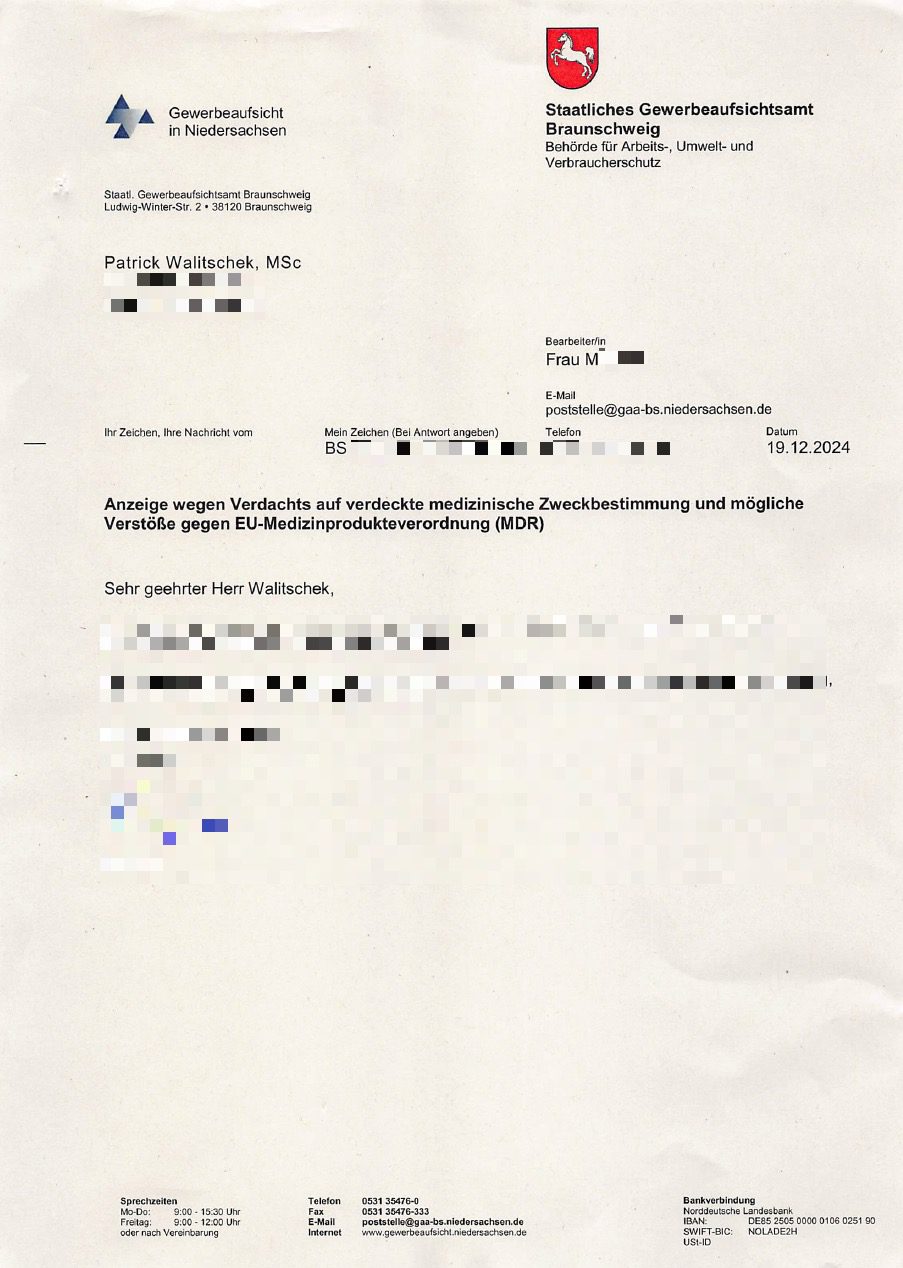
Warning letters and competition law issues for those affected
In addition to the criminal law consequences, those affected also face significant consequences under competition law. The Unfair Competition Act (UWG) prohibits misleading commercial practices (see UWG, Sections 3 and 5), stipulating that a provider of therapeutic or medical services must provide accurate information regarding their qualifications to perform the services offered. If such competence is lacking, this may lead to warning letters accompanied by claims for damages and injunctions. A physiotherapist or qualified alternative practitioner may therefore issue a warning letter to a fitness trainer offering microcurrent therapy, and should do so. A formal warning should be issued not least to protect patients and out of respect for the doctors and therapists who have invested a great deal of time and money in their training and studies (Zimmermann, 2012).
Richter (2018), as the operator of a physiotherapy practice, put it rather aptly:
“Competition in the healthcare sector is now being fought with no holds barred. Everyone wants to attract as many self-paying patients or privately insured individuals as possible, because it is mainly from these two target groups that profits are made! Just take a look at personal training. It is entirely self-funded by the clients and highly expensive to boot. Revenue from statutory health insurance schemes – if any is generated at all – tends, by contrast, to serve merely as a means of ensuring the basic viability of day-to-day operations. However, many self-employed physiotherapists are operating their practices on the financial brink of viability and must not only compete with other practices, but now also contend with Chinese or Thai massage parlours, numerous gyms, yoga providers and personal trainers” (Richter, 2017).
This is how the Federal Constitutional Court defines the practice of medicine subject to authorisation
The Federal Constitutional Court describes the purpose of the Heilpraktikergesetz (Law on Non-Medical Practitioners) as protecting the health of the population and refers to Article 12(1) of the Basic Law: “The health of the population is a particularly important common good […]. The fact that medical practice should not, in principle, be exempt from licensing makes sense in view of the protected interest of health.” (BVerfG, 2004)
Special Feature: Microcurrent Physiotherapy
As a rule, microcurrent therapy in a physiotherapy setting is a form of treatment that does not require a doctor’s prescription. This raises the question: can a physiotherapist carry out such treatment without a doctor’s prescription? The Administrative Court (VGH) ruled on this issue. “With at least 100 teaching hours in physiotherapeutic assessment and examination techniques, the physiotherapist is also qualified to carry out independent assessments within their field of practice and must demonstrate this knowledge as part of the practical component of their final examination.” The court went on to state: ‘[…] a doctor’s prescription typically specifies only the main symptom or the location of the complaints, and in practice, there are frequent reports of non-specific and largely inconclusive diagnoses. In the court’s view, the prescription is therefore only relevant for the reimbursement of treatment costs by health insurance providers, but not for the admissibility of carrying out treatments.” (Weigt, 2009)
Specific features of occupational therapy
As already described, LuXXaMed microcurrent devices are CE-marked medical devices. These devices are categorised within the field of electrotherapy. Alongside ultrasound and laser treatments, electrotherapeutic methods are also used in occupational therapy. There are training providers specialising in the application of electrotherapeutic methods within the field of occupational therapy.
Electrotherapy, a method used in occupational therapy, has proven effective in restoring grip function in tetraplegics (Popović 2006). It can also promote the recovery of movement in people with sensorimotor disorders (Popović 2002). However, further research is needed to define suitable indications for the selection of participants (Popovic 2006). The clinical benefits of EMG biofeedback training, a form of electrotherapy, have been documented in the field of occupational therapy (Hamilton 1983).
Research also demonstrates the effective use of electrotherapy in occupational therapy. Dionne (2020) used a questionnaire survey in occupational therapy practices involving 57 patients to investigate the extent to which the use of electrotherapy is beneficial for patients with spinal injuries.
It can be concluded from this that the use of electrotherapeutic methods, such as microcurrent therapy, is possible within the context of occupational therapy. Posts on internet forums indicate that appropriate training should be in place. In Germany in particular, this is already required by the MPBetreibV (Medical Devices Operator Ordinance).
The forum posts highlighted, on the one hand, the frequent use of medical devices, such as laser and ultrasound applications, in occupational therapy. This makes this practice comparable to that of physiotherapists.
Fitness, Wellness and Microcurrent
In addition to medical and therapeutic applications, the technology can, of course, be used in the fields of sports performance enhancement, fitness and wellness. Anyone may carry out such applications, provided that they do not fall within the scope of Section 1 of the Heilpraktikergesetz (Alternative Medicine Practitioners Act). Thus, an application (not a treatment, not a therapy) used on an athlete to aid faster recovery is therefore exempt and may certainly be carried out by a trainer, coach, etc.
Get your ebook now, packed with information on the application, science and areas of use. You’ll also receive a free newsletter and a personalised guided tour featuring videos and further information!
References
BVerfG. (2004). Judgment of the Federal Constitutional Court 2 BvR 1802/02. Accessed on 14 November 2018. Available at https://www.bundesverfassungsgericht.de/SharedDocs/Entscheidungen/DE/2004/06/rk20040603_2bvr180202.html
Dionne, T., Lenker, J., Hennessy, P., & Sullivan, J., 2020. Use of Electrical Stimulation for People With Spinal Cord Injury: A Survey of Occupational Therapy Practitioners. The American Journal of Occupational Therapy: Official Publication of the American Occupational Therapy Association, 74(3), pp. 7403205110p1–7403205110p7. https://doi.org/10.5014/ajot.2020.035584.
HeilprG. (1939). Act on the Professional Practice of Medicine without a Licence (Heilpraktikergesetz). Federal Law Gazette. Accessed on 14 November 2018. Available at https://www.gesetze-im-internet.de/heilprg/BJNR002510939.html
Popovic, M.R., Popovic, M.R., Thrasher, T.A., Thrasher, T.A., Adams, M., Adams, M., Takes, V.S., Zivanovic, V., & Tonack, M. (2006). Functional electrical therapy: retraining grasping in spinal cord injury. Spinal Cord, 44, 143–151.
Richter, V. (2017). Warning letters are an effective means of ensuring fair competition. Accessed on 14 November 2018. Available at http://relaxman-redaktion.blogspot.com/2017/03/abmahnungen-sind-ein-probates-mittel.html
Stebner, F. (Association of Independent Psychotherapists, Non-Medical Practitioners of Psychotherapy and Psychological Counsellors e.V., ed.). (2018). When does unauthorised medical treatment requiring a licence begin for psychological counsellors and coaches? Play it safe due to the difficulty in distinguishing it from permissible medical treatment not requiring a licence! Accessed on 14 November 2018. Available at https://www.vfp.de/verband/verbandszeitschrift/alle-ausgaben/69-heft-01-2015/577-when-does-unauthorised-medical-treatment-requiring-a-licence-for-psychological-counsellors-and-coaches-begin.html
Weigt, M. (IWW – Institute for Knowledge in the Economy, ed.). (2009). Treatment without a doctor’s prescription and without a licence to practise alternative medicine is lawful! (5th ed.). Accessed on 14 November 2018. Available at https://www.iww.de/pp/archiv/rechtsprechung-behandlung-ohne-aerztliche-verordnung-und-ohne-heilpraktikererlaubnis-rechtens-f42785
Zimmermann, B. (anwalt.de services AG, ed.). (2012). Coach – a profession without a legal framework? Accessed on 14 November 2018. Available at https://www.anwalt.de/rechtstipps/coach-ein-berufsbild-ohne-gesetzliche-norm_028150.html