BCR Therapy, microcurrent, LuXXaMed ‘Basic/Advanced Seminar’ 2019
In our view, therapy means seeing the person as a whole, i.e.: an individual who moves through soft tissues, is supported by the musculoskeletal system, is nourished by the digestive organs, is sustained by the respiratory organs, is cleansed by the excretory organs, and is powered by the cardiovascular system. All these functions are controlled by our nervous system. Restrictions in movement can cause problems in the following systems:
- parietal = musculoskeletal system
- visceral = organs
- cranial = craniosacral system
The soft tissues fixate our restrictions and thus reflexively adopt a spastic state. This leads to shortening, which in turn results in a loss of strength. These restrictions or problems are either primary or secondary in nature. For example, a primary parietal injury can cause a secondary injury.
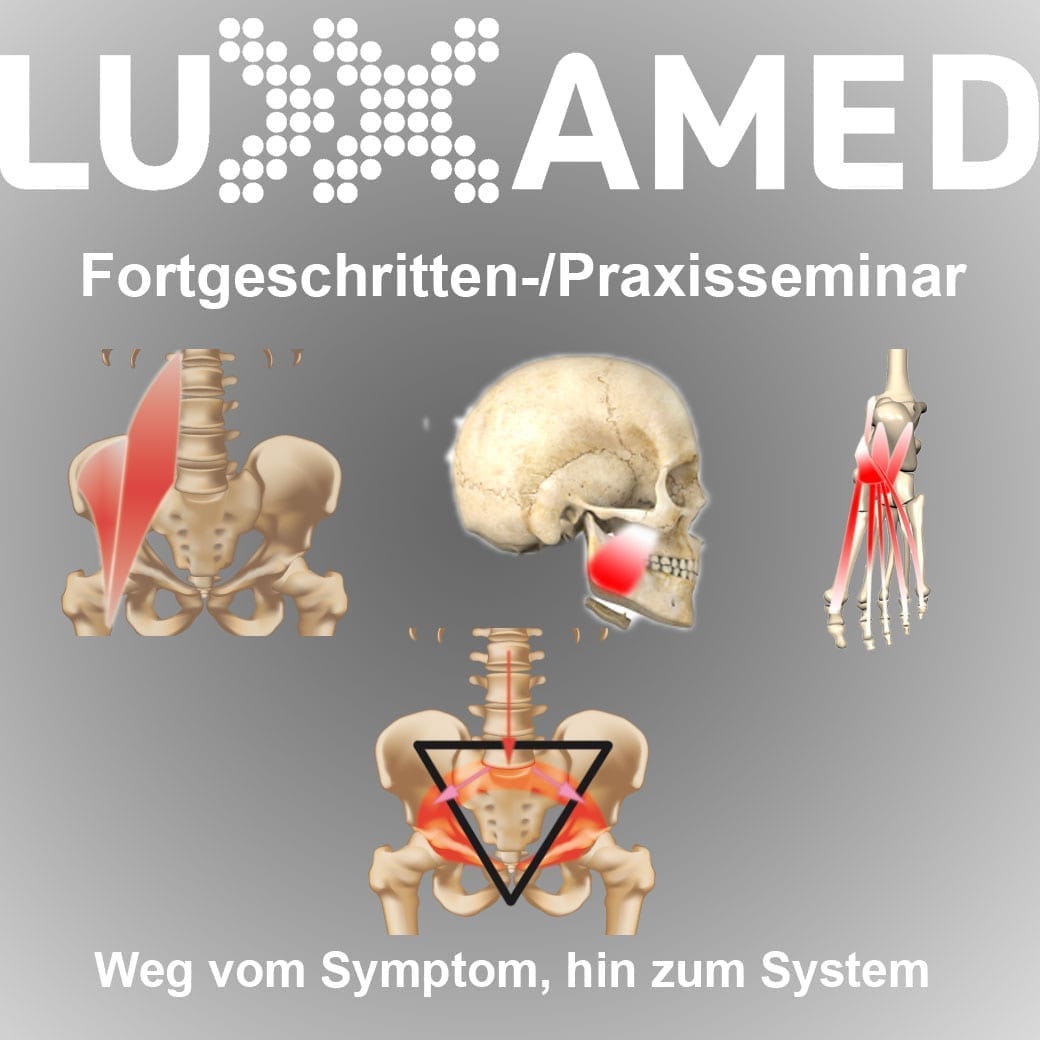
Moving away from the symptom, towards the system
The core component of the BCR therapy system lies in the examination of systemic processes within our body and how they interact with one another. Consequently, even complex clinical presentations can be assessed systemically and treated within the framework of BCR therapy. The patient provides continuous feedback, which gives you insight into the current ‘actual’ state and pathways to the ‘target’ state. This provides you with a clear and goal-oriented treatment method.
The advanced section of this seminar
Our musculoskeletal system – and thus the solid structures of our body – is essentially held together by forces of tension and stress. It can therefore be assumed that this system is based on a fundamental geometric structure. This fundamental structure can be found in many areas of our lives. For example, all carbon compounds, atoms, proteins, viruses and, of course, all cells are structured according to this fundamental geometric structure. This basic structure was first demonstrated in 1955 in New York by the architect Buckminster Fuller in a construction comprising struts that do not touch one another but are connected solely by tensile elements, such as ropes.
This clearly illustrates the connection with our bodily systems. Our bodily system is stabilised by bones, which in turn are held together by muscles, tendons and ligaments. The cohesion of this structure is maintained by tensile and compressive forces running through it. Thus, there is a balance between tension and compression. Tensile forces are transmitted along the shortest path. All matter on our planet is subject to the same spatial constraints, regardless of scale (size) or position.
Most conventional medical treatment methods assume that, when a part is injured, the local forces have overburdened the local tissue. Consequently, local relief measures or local therapies are deemed necessary and, in most cases, are applied. If we now consider our geometric model of the body, we get a completely different picture. Stability in our body is not maintained by rigidity or strength, but by the ability to absorb force or energy and distribute it throughout our entire system. To put it in exaggerated terms, one can imagine it like this: when force (such as that caused by trauma) is applied to a specific point in the structure, that point will yield due to the body’s compensatory capacity until it inevitably breaks. However, in most cases, this does not happen at the point where the force was applied! The principle of cause and effect. This also provides an explanatory model for why, for example, chronic Achilles tendinopathy can result from an injury or overuse of the shoulder.
Functional muscle system – reflex muscles
The reflex muscle system, or reflex muscles, is usually activated by trauma. This ‘response’ reduces mobility in the painful region and activates the body’s entire network of reflex muscles or myofascial muscle chains. As a result, the reduced mobility or the postural defence pattern adopted by the body can lead to further damage or injury.


Summary of the seminar content
- Fundamentals of microcurrent therapy
- Frequency-specific work with microcurrent and LuXXaMed
- Fundamentals of LED light therapy and ‘manual techniques’ using microcurrent and LuXXaMed
- Which electrode approach? Local, global, regulatory??
- The ‘2+4=1 concept’ by Matthias Rother
- Systematic application of adhesive electrodes
- The system of reflex muscles
- The 4 therapeutic areas
- The thoracic diaphragm as the foundation
- The ‘2+4=1 Concept’ by Matthias Rother in practical application
- Manual therapeutic support
- A therapeutic concept from head to toe!
Venue
You are currently viewing a placeholder content from Google Maps. To access the actual content, click the button below. Please note that doing so will share data with third-party providers.
More InformationPrice
- Includes meals for the day
- Includes seminar materials
Seminar times
10.00 am to 6.00 pm
Registration deadline
3 weeks before the start of each seminar