Microcurrent therapy – Galvanic microcurrent
What exactly is microcurrent, or galvanic microcurrent, and how does it differ from microcurrent therapy?
Many people suffer from pain over a prolonged period that cannot be significantly alleviated by conventional methods. One option for alternative pain treatment is, for example, microcurrent therapy. It is used not only by doctors, but also by alternative practitioners and physiotherapists.
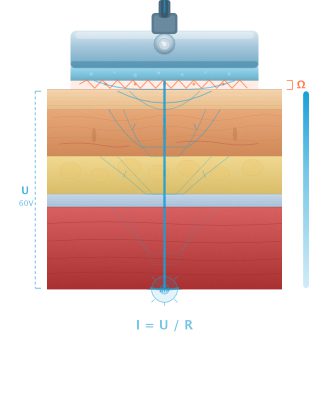
But microcurrent is not only used in these cases; it is also frequently employed to treat circulatory disorders or to stimulate the body’s self-healing abilities. Galvanic microcurrent therapy Galvanic microcurrent therapy is a holistic form of therapy. It is based on the fact that human skin consists of several layers. It is structured like an onion. The outermost layer of skin consists of keratinised cells.
The application of microcurrent smooths the skin’s surface. Furthermore, microcurrent therapy can help flush out toxins trapped within the skin. The body’s self-healing powers are activated. The skin’s surface becomes firmer, and existing wrinkles can be smoothed out. This is why microcurrent therapy is also used to treat blemished skin. Meridians, nerves and microcurrent The human body has what are known as main meridians, which run through the body like nerve pathways. The meridians are indirectly connected to various human organs. Eight of these meridians have a direct connection to the head and face. When galvanic microcurrent is applied to the face, this has the effect of positively strengthening the meridians that run alongside one another. Naturopaths describe this as the microcurrent stimulating the flow of energy throughout the entire body. The entire meridian system is stimulated whilst, at the same time, the connective tissue is strengthened. The mode of action of the galvanic microcurrent, particularly in the field of naturopathy, is based on the assumption that life on Earth is to be regarded as part of nature. Consequently, the human body can be effectively supported in a natural way to activate its own self-healing powers. Microcurrent therapy is a form of treatment that harnesses these powers. It supplies the body with a small amount of electrical current, which is normally present in the human body.
The microcurrent supplied has a stimulating effect on the self-healing process. It normalises the function of the nervous system and, furthermore, releases blockages in the body’s energy flow. The blood vessels are dilated by the flow of the microcurrent. This process involves the flow of ions, which has a harmonising effect throughout the body, right down to the individual cells. The antiseptic effect is also enhanced, for example to prevent infections following surgery.
The microcurrent also has an electrolytic function. As the current flows through the body, positively and negatively charged proteins are shifted towards their respective opposites and thus directed towards the excretion process. This process supports the gradual breakdown of vascular deposits.

Microcurrent therapy is not the same as microcurrent therapy
Microcurrent therapy and frequency-specific microcurrent therapy are not the same thing, although both are forms of electrotherapy and utilise weak currents.
In microcurrent therapy, also known as galvanic microcurrent, a constant direct current of very low intensity – often less than one milliampere – is used. It is believed that this current helps the cells to function more efficiently and supports the healing process.
The scientific significance of microcurrent therapy is disputed. Some studies suggest that it can relieve pain, support the healing process and may help with certain neurological disorders. However, many of these studies have shortcomings, and the exact mechanisms through which microcurrent therapy might work are not well understood.
Microcurrent in the context of physics
‘Microcurrent’ is not a term that is generally recognised or used in physics. Its exact meaning may therefore vary depending on the context, but it appears that the term is most commonly used in alternative medicine or health-related contexts, often in connection with theories about the flow of energy through the body.
In physics, the term ‘current’ normally refers to the flow of electrically charged particles. ‘Fine current’ could refer to a very weak current, but this term is not standardised or generally recognised.