Not all microcurrents are the same
The interplay of therapeutic parameters from a biophysical perspective
Microcurrent therapy has become increasingly established in recent years. At the same time, a recurring misunderstanding has emerged in practical application: microcurrent is often reduced to a single active factor – frequency. In training courses, user groups and online discussions, much of the focus revolves around the question of which frequency is ‘the right one’.
This perspective is understandable, but it falls short. This is because microcurrent is not a one-dimensional frequency therapy, but a complex biophysical mechanism of action in which several parameters interact simultaneously.
Microcurrent as a comprehensive biophysical system
From a physical perspective, microcurrent is an electric current in the microampere range. And like any electric current, it is described by several fundamental quantities. These include, in particular, current, voltage, frequency, as well as polarity and waveform.
In terms of therapeutic effect, these parameters never occur in isolation. They overlap, influence one another and only exert their effect when acting in concert. This is precisely why it makes sense to view microcurrent as a holistic system – not as the sum of individual settings.
The frequent focus on frequencies alone is problematic because it suggests that a single parameter is responsible for the biological response. In reality, however, it is the combination of all these factors that determines how a tissue reacts to the electrical stimulus.
Current strength: precisely calibrated stimuli rather than stimulation
A key feature of microcurrent therapy is the very low current intensity. Currents measured in microamperes lie well below the human perception threshold. Unlike with nerve stimulation or muscle stimulation techniques, the aim is not to actively stimulate nerves or muscles.
Rather, the microcurrent operates within a range that more closely approximates natural electrical processes at the cellular level. Cell membrane potentials, ion transport and electrochemical gradients are highly sensitive to very low stimuli. Conversely, excessively high current levels can trigger stress responses or counter-regulatory mechanisms.
The current strength therefore plays a decisive role in determining whether a stimulus is perceived as regulatory or disruptive.
Voltage: The often underestimated factor
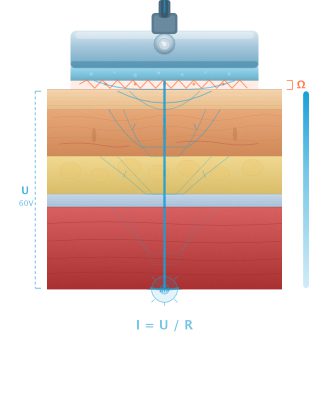
Voltage also plays a central role, yet is often given little consideration in practice. It influences whether the current can penetrate the skin barrier, how deeply it penetrates the tissue, and how electric fields are established.
If the voltage is too low, the current remains effective only at the surface. If it is too high, the characteristics of the stimulus change. What is crucial is not a maximum value, but a functionally appropriate setting that corresponds to the condition of the tissue in question.
Frequency: a structuring factor, not the sole determinant
Frequencies structure the current over time. They determine the rhythm at which electrical signals are delivered to the tissue. Frequencies can address specific conditions, modulate processes and convey information.
However, they only exert their effect in the context of the other parameters. A frequency without the appropriate current strength remains ineffective. A frequency without sufficient voltage does not reach the target tissue. And a frequency without the correct polarity can lead to a completely different biological response.
Frequencies are therefore comparable to notes in an orchestra: essential, but not sufficient on their own.
Polarity and signal shape: direction and dynamics
Polarity and signal shape influence, amongst other things, the direction of ion movement, the strength of electric fields and the dynamics of the stimulus. In microcurrent therapy, square-wave signals are predominantly used; these can be positive, negative or bipolar.
Here, too, the principle applies: small changes can result in significant differences in the biological response. Therefore, polarity and signal shape are not merely incidental settings, but integral components of the principle of action.
Biological tissue is not a static system
Another crucial point is the dynamics of biological systems. Tissue is constantly changing. Electrical resistances fluctuate, metabolic processes adapt, and regulatory mechanisms respond to external stimuli.
A static treatment protocol can only accommodate these dynamics to a limited extent. What makes sense at one moment may be inappropriate at a later stage. This is precisely where purely manual parameter adjustment reaches its limits.
The role of cybernetic automatic systems
Cybernetic automated systems address precisely this issue. They record measurable biophysical properties of the tissue, such as resistance curves or response patterns, and dynamically adjust current, voltage, polarity and timing sequences.
In doing so, they do not make medical diagnoses nor do they replace therapeutic decisions. Responsibility for the indication, treatment strategy, electrode placement and clinical assessment remains entirely with the therapist.
Rather, the automated system supports those subtle adjustment processes that take place at a purely physical level and are largely beyond human perception. In medical applications in particular, this form of automation can contribute to greater consistency, safety and reproducibility.
Microcurrent requires understanding – or intelligent support
Microcurrent is not a simple therapy. It is subtle. It is complex. And it requires an understanding of regulatory processes rather than rigid protocols. This understanding can grow through experience or be supported by systems that reliably map biophysical relationships.
Anyone who views microcurrent solely as a frequency-based concept is squandering a large part of its potential. Those who, on the other hand, understand it as a regulatory, biophysical tool, considerably expand their scope for therapeutic intervention.
Conclusion: It’s the orchestra that decides
The effect of microcurrent therapy does not arise from a single parameter. It arises from the interplay of all influencing factors. Just as in an orchestra, it is not the individual instrument that decides, but the coordinated collaboration of all those involved.
A deeper understanding of these interrelationships enables a more nuanced application, more realistic expectations and an objective assessment of the therapeutic possibilities.
Anyone wishing to understand microcurrent therapy should therefore not search for the one correct frequency, but rather for the right interplay.