Understanding chronic wounds: Why standard care remains the foundation – and where microcurrent can be usefully incorporated
Chronic wounds are rarely just a localised skin problem. Delayed healing usually occurs when several barriers coincide: non-viable tissue, persistent inflammation, infection, moisture imbalance, inadequate perfusion or relevant patient-related factors. Anyone wishing to treat chronic wounds effectively must therefore look not only at the wound surface, but at the entire biological and functional environment.
Pressure ulcers and venous ulcers are not the same thing
In day-to-day clinical practice in particular, chronic wounds are often viewed too broadly. Yet the causes differ significantly. In the case of pressure ulcers, the main factors are persistent pressure, shear forces, restricted mobility, sensory disturbances and, frequently, impaired nutritional status. With venous leg ulcers, the underlying situation is different: they are considered the most severe form of chronic venous insufficiency, are described as C6 in the CEAP classification, and must be regarded as chronic wounds from the outset.
Basic treatment is essential
This is precisely why good wound care does not begin with an additional procedure, but with a thorough investigation of the underlying causes and basic treatment in line with guidelines. For pressure ulcers, NICE recommends, amongst other things, regular repositioning, pressure-relieving care, high-specification foam mattresses and a nutritional assessment by qualified healthcare professionals. Adults at risk should be repositioned at least every six hours; those at high risk, at least every four hours. For existing pressure ulcers, NICE also recommends high-specification foam mattresses and a structured nutritional assessment.
The situation is equally clear for venous leg ulcers: the current AWMF guideline defines medical compression therapy, following assessment of relevant contraindications, as standard conservative treatment and states that it accelerates healing. At the same time, it is emphasised that the full effect of compression is only realised when the muscle and joint pumps are activated. Therefore, regular physical activity, walking exercises, foot exercises and, where necessary, mobilisation of the ankle joint should not be treated as peripheral elements, but placed at the heart of the treatment plan.
Why bioelectrics is relevant to wound healing at all
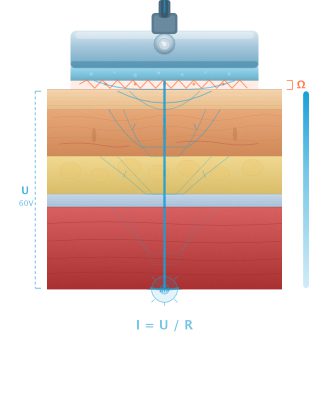
Things become particularly interesting when wound healing is viewed not only from a biochemical but also from a bioelectrical perspective. Following an injury, the skin’s transepithelial potential changes, and endogenous electric fields arise which may play a role in re-epithelialisation. Recent review articles describe how electric fields can influence the directional migration of cell clusters, particularly keratinocytes. It is precisely this directional cell migration that is biologically relevant to wound closure.
The bioelectrical perspective is therefore by no means an esoteric side track, but a mechanistic approach that should be taken seriously. The key is to put this into the right context: biological plausibility alone does not constitute a clinical recommendation. However, it does provide a coherent framework for understanding why microcurrent and other forms of electrical stimulation are being investigated in wound healing in the first place.
What the evidence on microcurrent currently shows
A meta-analysis of randomised trials is particularly relevant for clinical interpretation. This analysis involved a qualitative review of eight randomised clinical trials and a quantitative analysis of seven trials involving a total of 337 participants. The results showed that microcurrent therapy, when used in addition to standard wound care, was associated with a greater reduction in wound area, a shorter healing time and lower pain intensity. The authors assess the therapy as effective and safe, but at the same time emphasise the need for better standardised study protocols and reduced susceptibility to bias.
Of particular interest for clinical practice is a randomised, double-blind study involving older people with pressure ulcers. Both groups received a standardised wound care protocol; the intervention group additionally received ten hours of microcurrent therapy daily over 25 days. The result: wound healing improved more significantly in the microcurrent group – both qualitatively and quantitatively – than in the sham group. This is also important for interpretation: microcurrent was used here not as a replacement for, but as a supplement to, standard care.
A scientifically honest assessment
A level-headed perspective is crucial, particularly for professional practitioners. Although the available data is interesting, NICE currently continues to recommend that electrotherapy should not be offered for the treatment of pressure ulcers in adults. This does not contradict the existing body of research, but rather reflects evidence-based care: there are positive signs, but from a guideline perspective, there is not yet a sufficiently robust basis for a general recommendation. Anyone communicating about microcurrent in a responsible manner should not gloss over this tension, but rather address it transparently.
What does this mean in practice?
The most important practical implication is: first address the aetiology, then consider add-on therapies.
In the case of pressure injuries, this means: reduce pressure, assess risk, position the patient correctly, consider skin care and nutrition, and document progress. In the case of venous ulcers, this means: addressing the venous cause, applying compression correctly, encouraging movement, improving mobility and clearly clarifying any contraindications. Only once this foundation is in place can microcurrent be professionally and sensibly classified as a complementary bioelectrical approach.
This is equally relevant for external communication. Scientifically sound wording would not be ‘microcurrent heals chronic wounds’, but rather: For certain chronic wound conditions, there is clinical data suggesting that the complementary use of microcurrent alongside standard care may be of interest. It is precisely this cautious, evidence-based communication that is also consistent with the LuXXaMed documentation, which explicitly states that any statements do not constitute a promise of a cure and that professional users must comply with the regulatory requirements for medical devices.
Conclusion
Chronic wounds are systemic problems with local manifestations. Treating only the surface often falls short. Those who consider the cause, the tissue environment, mobility, venous or pressure-related mechanics and wound biology in conjunction provide more precise treatment. It is precisely at this interface that the bioelectrical perspective becomes particularly interesting: not as a substitute for standard therapy, but as a complementary approach that is biologically plausible and is being further investigated clinically.
You may also find this interesting:
Radialislähmung nach Schulter-TEP
https://www.luxxamed.de/2026/04/13/radialislaehmung-nach-schulter-tep/
Sources (selection)
Avendaño-Coy, J., López-Muñoz, P., Serrano-Muñoz, D., Comino-Suárez, N., Avendaño-López, C., & Martín-Espinosa, N. M. (2022). Electrical microcurrent stimulation therapy for wound healing: A meta-analysis of randomised clinical trials. Journal of Tissue Viability, 31(2), 268–277. https://doi.org/10.1016/j.jtv.2021.12.002
Avendaño-Coy, J., Martín-Espinosa, N. M., Ladriñán-Maestro, A., Gómez-Soriano, J., Suárez-Miranda, M. I., & López-Muñoz, P. (2022). Effectiveness of microcurrent therapy for treating pressure ulcers in older people: A double-blind, controlled, randomised clinical trial. International Journal of Environmental Research and Public Health, 19(16), 10045. https://doi.org/10.3390/ijerph191610045
German Society for Phlebology and Lymphology e. V. (2024). S2k Guideline on the Diagnosis and Treatment of Venous Leg Ulcers (AWMF registration number 037-009, version 4.1). Association of Scientific Medical Societies.
National Institute for Health and Care Excellence. (2014). Pressure ulcers: prevention and management (CG179). NICE. Current recommendations.
Zhang, Y., Huang, S., Cao, Y., Li, L., Yang, J., & Zhao, M. (2025). New opportunities for electric fields in promoting wound healing: Collective electrotaxis. Advances in Wound Care, 14(8), 418–428. https://doi.org/10.1089/wound.2024.0003