Open-ended prescriptions in physiotherapy – how microcurrent can be used effectively and in accordance with regulations
Since 1 November 2024, a new avenue has opened up in physiotherapy care: The so-called ‘blank prescription’ – officially known as ‘treatment provision with extended responsibility’ – allows physiotherapists to decide for themselves on the type, frequency and duration of therapy. The prerequisite is that the doctor has clearly defined the diagnosis and the treatment objective. For physiotherapy, this regulation initially applies to defined shoulder diagnoses from the so-called EX group, with a duration of up to 16 weeks. This offers new scope – but also a clear obligation to choose a form of therapy that is cost-effective, appropriate and medically justified.
In this article, we examine how medical microcurrent therapy – particularly using devices such as the LuXXaMed – can be appropriately and compliantly integrated into the mix of therapeutic measures. In doing so, we also take a look at the biophysical principles, current studies and practical implementation in day-to-day practice.
What is a blank prescription – and what does it mean for electrotherapy?
In the case of a blank prescription, the therapeutic practice assumes responsibility for the specific design of the therapy. This means that it decides on the combination of measures, the frequency of therapy and the duration of treatment within the specified framework. This also means that the choice of complementary procedures, such as electrotherapy, is the responsibility of the treating practice – provided that the chosen measures are medically necessary, cost-effective and targeted (§ 12 SGB V).
Is microcurrent a treatable measure? Yes – within the scope of electrotherapy
Within the classification system for the provision of therapeutic treatments, microcurrent falls under electrotherapy and is therefore billable, provided it is used appropriately. Annex 1 of the framework agreement pursuant to Section 125 of the German Social Code, Book V (SGB V) explicitly describes, under service code X1302, the application of galvanic, low- and medium-frequency currents – with objectives such as pain relief, improved blood circulation, regulation of muscle tone and reduction of swelling. The use of microcurrent within these objectives is therefore, in principle, covered.
It is important to note that the treatment must be adapted to the patient’s individual response. Furthermore, Annex 1 requires documentation of the patient’s progress – which is consistent with the characteristic, feedback-controlled use of modern microcurrent devices such as the LuXXaMed.
What does this mean in practical terms for treatment planning?
The expanded scope of care offers many opportunities, but also requires clear therapeutic decisions. Microcurrent does not replace core manual therapy services such as physiotherapy, manual therapy or manual lymphatic drainage. However, it can be a useful, complementary component – for example, for pain modulation, muscle tone regulation or reducing swelling. Particularly in the case of post-operative or painful conditions that make active patient participation difficult, microcurrent can help to facilitate the start of therapy.
What does the evidence say about the effectiveness of microcurrent for musculoskeletal conditions?
The evidence is mixed, but promising in several areas. A randomised study by Yi et al. (2021) investigated the use of microcurrent following rotator cuff reconstructions. Significant improvements in pain, shoulder function and grip strength were already evident in the early post-operative period. There is also evidence of an analgesic effect in knee osteoarthritis – a four-arm trial with a placebo group showed positive trends in favour of the microcurrent group, although larger studies are still needed.
Furthermore, a systematic review by Iijima and Takahashi (2021) provides moderate evidence of pain relief in musculoskeletal conditions. The authors emphasise the importance of individualised dosing and transparent parameter selection.
Why does microcurrent fit so well, functionally speaking, into modern tissue therapy?
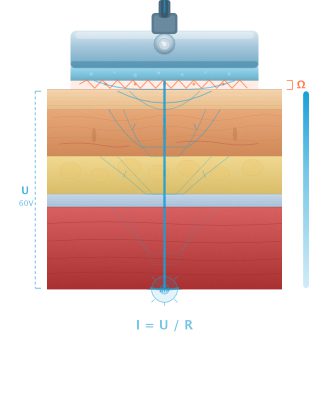
Unlike conventional electrical stimulation methods, microcurrent acts sub-sensorily – that is, below the threshold of perception. It influences the electrical and ionic gradients of the tissue, modulates impedance, supports microcirculation and can thus promote regenerative processes. It does not follow a rigid protocol but is – ideally – adapted responsively: to the tissue, to the clinical response, and to the findings on a day-to-day basis. This ‘tissue response’ forms the core of modern, adaptive electrotherapy.
In the context of a functional, biophysically based therapy, microcurrent thus becomes a cybernetic element within the overall system: flows follow gradients, whilst changes in cell potential and enthalpy influence the state of the tissue. Such approaches can be combined wonderfully with active, manual and educational methods.
How can microcurrent be used in practice under a blank prescription?
A typical procedure could be carried out in five steps:
-
Clarify findings and objectives: key symptoms, ICF-oriented, e.g. pain, mobility, sleep quality.
-
Plan a combination of interventions: core interventions such as physiotherapy, manual therapy and exercise; supplemented by microcurrent for pain modulation or reducing swelling.
-
Consider parameters and safety: MDR-CE-compliant device, documented induction, compliance with the Medical Devices (Operators) Regulation (MPBetreibV).
-
Adapt the treatment: Adjust electrode placement, programme duration and frequencies to the patient’s response.
-
Assess cost-effectiveness: Record and document treatment outcomes; if no progress is made, adjust the treatment specifically or discontinue it.
Sample wording for documentation:
-
Indication/aim: “Previous shoulder diagnosis with pain and restricted range of motion (ROM); treatment aim: pain relief, functional rehabilitation.”
-
Intervention: “Physiotherapy/manual therapy + exercise programme; supplemented by electrotherapy X1302 (microcurrent, subsensory) for pain modulation/muscle tone regulation; 15 mins.”
-
Parameters: “Electrodes near the supraspinatus/deltoid, 15 mins, low-frequency pulse waveform, subsensory intensity.”
-
Progress: “NRS reduced from 6 to 4, abduction +15°, no side effects.”
-
Cost-effectiveness: “Intervention appropriate to the aim; continuation under a blank prescription, re-evaluation in 1 week.”
Simple algorithms for typical applications:
-
Post-operative shoulder (rotator cuff): Microcurrent to provide analgesic support for active therapy. Weekly review (e.g. SPADI, ROM), gradual tapering off once therapeutic goals have been achieved.
-
Chronic impingement: Microcurrent in combination with eccentric exercises, patient education and manual therapy. Aim: phased pain reduction, progression through active loading.
-
Knee osteoarthritis: Microcurrent as a modular supplement during the rehabilitation phase, e.g. before the exercise session in cases of pain on weight-bearing.
Regulations and quality: Three key points that must be in place
-
Be familiar with the regulations: G-BA guidelines, contracts under Section 125 of the German Social Code, Book V (SGB V), and statutory health insurance (GKV) information on blank prescriptions.
-
Ensure cost-effectiveness: Every measure must be appropriate, sufficient and cost-effective – and must be documented.
-
Ensure correct use of equipment: CE-compliant, training provided, operator obligations (e.g. STK/MTK) complied with.
Conclusion: Microcurrent – a building block with potential
Blank prescriptions mean freedom – but also responsibility. When used in a targeted and tailored manner, microcurrent can be an evidence-based and compliant component of therapy. It can usefully complement basic therapy, particularly in cases of pain, muscle tone problems and oedema. What is crucial here is not only the medical indication, but also accurate documentation and the continuous evaluation of the treatment.
Practical tip:
Do not use microcurrent as a standard measure, but as a precise tool in the context of the ‘tissue response’. The better you understand and document your patient’s response, the greater your therapeutic scope will be – including from a financial perspective.
Sources
GKV-Spitzenverband. (2023). Guidelines on Therapeutic Agents and Annex 1 to the Framework Agreement pursuant to Section 125 of the German Social Code, Book V (SGB V). Retrieved from https://www.gkv-spitzenverband.de
Iijima, H., & Takahashi, M. (2021). Efficacy of microcurrent therapy for musculoskeletal pain: A systematic review and meta-analysis of randomised controlled trials. Pain Practice, 21(2), 207–225. https://doi.org/10.1111/papr.12958
Yi, C., Chen, C. H., Lin, H. Y., Hsieh, Y. L., Huang, Y. C., & Yang, C. C. (2021). The effect of microcurrent electrical neuromuscular stimulation on pain reduction and functional improvement in patients following rotator cuff repair: A randomised controlled trial. Clinical Rehabilitation, 35(9), 1258–1267. https://doi.org/10.1177/02692155211020352
Walitschek, P. (2024). Scientific evidence on the effects of LuXXaMed microcurrent devices based on a literature review. Kassel: Luxxamed GmbH.