Chronic back pain: Why ‘back’ is not a diagnosis – and where microcurrent stands from a medical perspective
Back pain is the most common widespread ailment in Germany. Almost everyone is familiar with it, and many struggle with it on a long-term basis. But if you really want to understand chronic back pain, you need to take a step back – because ‘back’ is not a location. ‘Back’ is a signal.
In our new podcast episode, we explore precisely this question: What lies behind chronic back pain, what do current guidelines actually recommend – and what role can microcurrent play as a complementary measure in the treatment plan?
More than just a structural problem
When back pain persists for longer than twelve weeks, doctors refer to it as chronic lower back pain. This group is particularly relevant from a clinical perspective – as it is one of the most common causes of incapacity for work, early retirement and a lasting reduction in quality of life in Germany.
What makes chronic back pain so persistent? The answer often lies not in the back itself. The current National Care Guideline (NVL) on Non-specific Lower Back Pain makes it clear that chronic back pain is an expression of complex biopsychosocial processes. In addition to structural changes to joints, intervertebral discs and muscles, psychosocial factors such as work-related stress, emotional history and psychological distress play a significant role. In this context, Manigold, Gantschnig and Streitberger (2022) emphasise that guidelines therefore not only recommend the assessment of psychosocial risk factors, but also explicitly advocate a multi-professional treatment approach.
This explains why purely local treatment approaches for chronic back pain so often fail. Those who treat only where it hurts often overlook what is really perpetuating the pain.
What the guidelines actually recommend
The NVL is clear in its recommendation: if lower back pain persists for longer than six weeks, multimodal therapy should be initiated – a combination of exercise therapy, pain management and psychosocial support. Passive measures alone are not sufficient. Electrotherapy methods such as TENS are not listed as standard recommendations.
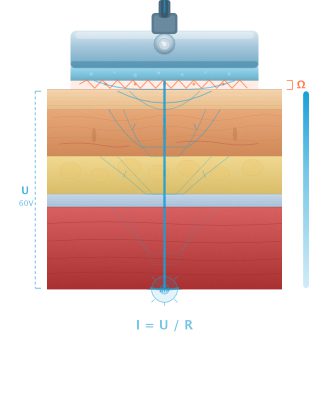
An important distinction must be made here: microcurrent is not simply TENS at a lower dosage. The key difference lies in the postulated mechanism of action. Whilst TENS primarily targets the gate control theory, microcurrent in the microampere range is intended to mimic the tissue’s physiological endogenous currents and thus support regulatory processes at the cellular level. Therefore, guidelines on TENS must not be directly applied to microcurrent – nor vice versa.
What the evidence on microcurrent shows
Scientific integrity is crucial here. In a systematic review, Iijima and Takahashi (2021) summarised the RCT evidence on microcurrent for musculoskeletal pain. The result: for shoulder and knee pain, significant effects were demonstrated compared with sham controls. In the case of chronic lower back pain, the meta-analysis failed to show any significant difference between groups – which the authors attribute primarily to the considerable heterogeneity of the clinical picture.
However, real-world data provide interesting supplementary insights. In a case series involving 22 treatment-resistant patients with chronic myofascial back pain, McMakin (2004) describes a statistically significant 3.8-fold reduction in pain intensity on the visual analogue scale over an average of 5.6 weeks. Methodologically, this is a case series without a control group – but clinically noteworthy because none of the patients had previously responded adequately to conventional treatments.
More conclusive is a retrospective cohort study by Shetty (2020), in which 761 patients were evaluated over three years across more than 3,280 clinic visits. The results show that frequency-specific microcurrent, when used as an adjunct to an active rehabilitation programme, reduced pain and functional limitations significantly more than rehabilitation alone. In a German observational study, Bünemann and colleagues (2023) also followed 48 participants with chronic lower back pain over six months and recorded their health-related quality of life – as an indicator of their ability to cope with everyday life under real-world conditions.
In addition, LuXXaMed GmbH’s own PMCF study (2021) provides clinical data from 1,417 treatments carried out by 21 professional practitioners. For spinal complaints, an average reduction in symptoms of 40.51 per cent was observed following treatment. These figures are taken from an observational study without a control group – yet they remain relevant as a real-world dataset for professional users.
A sound assessment
What can be said with scientific rigour? In cases of myofascial back pain with a trigger point component, there is clinical evidence of an additive benefit from microcurrent. As a complement to an active rehabilitation programme, frequency-specific microcurrent shows positive results in terms of pain relief and functional improvement. There is a lack of robust RCT evidence for its use on its own without accompanying active therapy.
Microcurrent is no substitute for structured rehabilitation. It is not a miracle cure. What it can be: a well-tolerated, adjunctive tool that alleviates pain, supports homeostasis and facilitates active therapy – provided that the diagnosis, treatment strategy and patient profile are clear.
This is exactly what we discuss in the new episode – in a nuanced, evidence-based way and without exaggeration.
🎧 Listen now: LuXXaMed Podcast, Episode 3 – Chronic Back Pain
Sources
Bünemann, L., et al. (2023). Observational study to assess the efficacy and safety of microcurrent therapy with a portable device in patients suffering from chronic back pain, skeletal system pain, fibromyalgia, migraine or depression. Medical Devices: Evidence and Research, 16. https://doi.org/10.2147/MDER.S436667
Iijima, H., & Takahashi, M. (2021). Microcurrent therapy as a therapeutic modality for musculoskeletal pain: A systematic review accelerating the translation from clinical trials to patient care. Archives of Rehabilitation Research and Clinical Translation, 3(3), 100145. https://doi.org/10.1016/j.arrct.2021.100145
LuXXaMed GmbH. (2021). PMCF study HD2000+ – Post-Market Clinical Follow-up, period 06/2019–08/2021. Internal evaluation, Kassel.
Manigold, T., Gantschnig, B. E., & Streitberger, K. (2022). A multi-professional treatment approach for chronic low back pain. Journal of Rheumatology, 81(9), 768–776. https://doi.org/10.1007/s00393-022-01258-6
McMakin, C. (2004). Microcurrent therapy: A novel treatment method for chronic low back myofascial pain. Journal of Bodywork and Movement Therapies, 8(2), 143–153. https://doi.org/10.1016/S1360-8592(03)00116-6
National Care Guideline on Non-specific Lower Back Pain. Medical Centre for Quality in Medicine (ÄZQ) & AWMF. Currently valid version. https://www.awmf.org
Shetty, G. M. (2020). Effect of adjuvant frequency-specific microcurrents on pain and disability in patients treated with physical rehabilitation for neck and low back pain. Complementary Therapies in Clinical Practice, 40, 101199. https://doi.org/10.1016/j.ctcp.2020.101199