Movement in Sport and Therapy – Microcurrent as a Bridge
Interview with Dr Gharavi
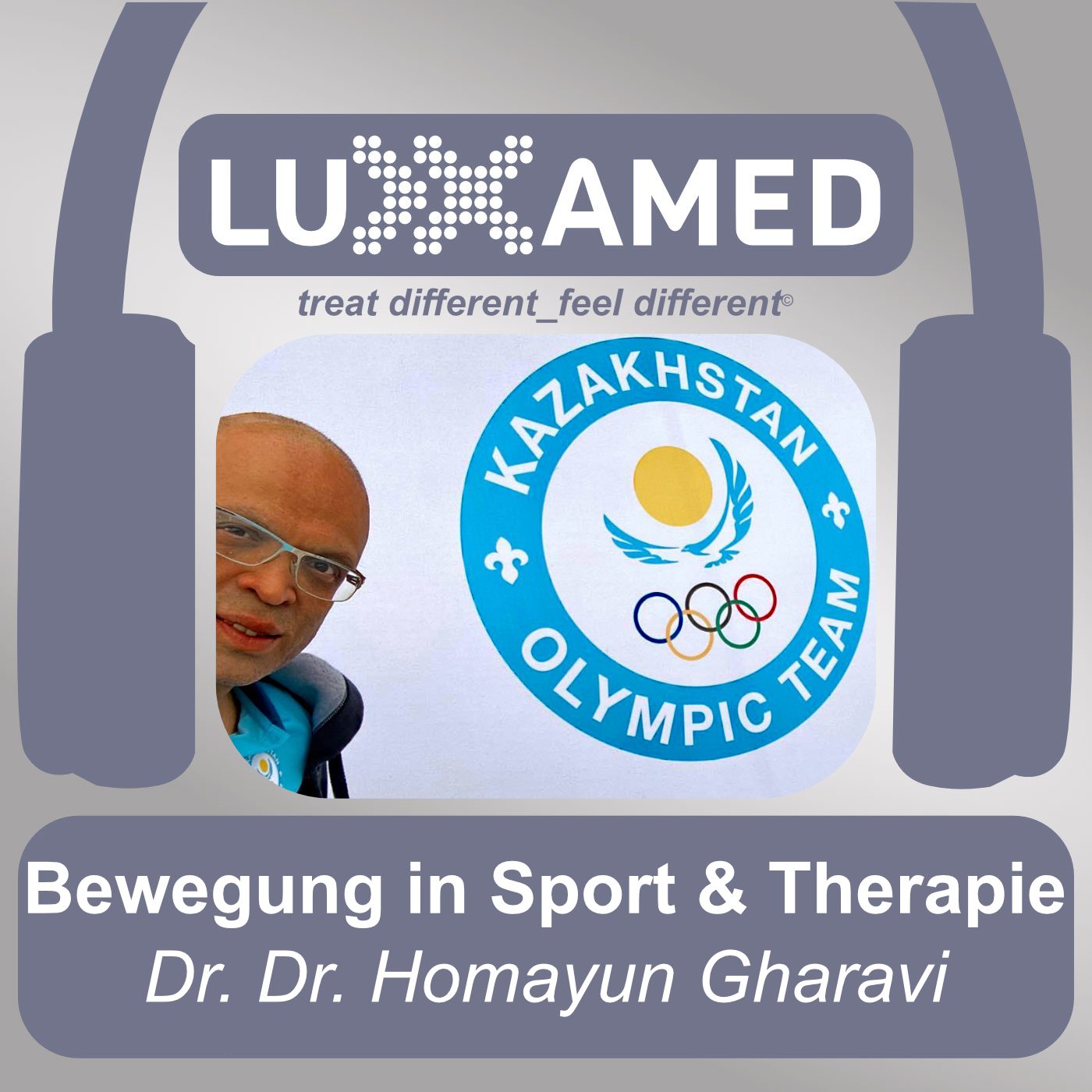
The doctor and sports scientist – Dr med. Dr disc. pol. Homayun Gharavi – uses microcurrent therapy in his practice in Lüneburg. His approach with athletes and patients involves dynamic muscle training that integrates the entire muscle chain.
Dr Dr Gharavi is also the founder and director of the German Academy for Applied Sports Medicine. Since 1997, he has travelled the world as a team doctor and fitness coach for various Olympic teams.
Function and movement, free from ‘supportive’ measures such as medication, are synonymous with health. Throughout the natural world, life is impossible without movement. Dr Dr Gharavi draws an analogy with the plant kingdom: without movement, reproduction – and thus the preservation of a species – is impossible. Anything that becomes rigid is not viable, and for this reason, isometric exercises and anything that restricts movement are not to be found in his practice.
‘Every injury has its own logic, and the treatment must be tailored to that logic’ – yet ultimately, it is the athlete who decides; it is the patient who decides whether the measures taken and the treatment prescribed are appropriate or not.
In this episode, Dr Gharavi also reports in detail on the upcoming Olympic Games in Tokyo and the challenges that must be overcome in the run-up to the event.
With two LuXXaMed devices in his luggage, Dr Gharavi intends to set up a small (but excellent) therapy station to use LuXXaMed microcurrent specifically to improve the athletes’ recovery and, if the need arises, to apply the therapy in traumatology as well. Although, hopefully, the latter will not be needed, or only very rarely.
Links for this episode:
4D PRO®: https://www.4dpro.de
Dr Dr Homayun Gharavi – Private practice: https://gharavi.de
Transcript of this episode
00:00:00
Interviewer: Every injury has its own logic, and the treatment must be tailored to that logic. Ultimately, however, it is the athlete – the patient – who decides whether a particular course of action or treatment is effective and successful or not. And with that, a warm welcome to a new podcast episode from LuXXaMed GmbH. My name is Patrick Walitschek and this week, in this episode, I’ve once again brought you an absolutely fascinating interview – this time with the doctor and sports scientist Dr Dr Gharavi from Lüneburg. We discussed the topic of movement, as this is one of his specialist areas – movement in sport, in rehabilitation and, consequently, in therapy. He has also developed a specialised training device for this purpose and, of course, makes specific use of the LuXXaMed microcurrent here. And for him – as he describes very, very eloquently in the interview – the ability to function and move freely, without the need for supportive measures such as medication and the like, is, in principle, synonymous with health. A lovely analogy is drawn from nature: in nature, too, life is impossible without movement. But I don’t want to give too much away. The episode naturally covers the topics of sport, exercise and therapy, but we also talk about the 2021 Olympic Games in Tokyo, as Dr Gharavi is there with the Kazakhstani Olympic team and describes a little bit about how the Olympic Games actually unfold from a doctor’s perspective, having already been to several Games in the past. And, importantly for anyone interested, we’re also in close contact via social media. On our Instagram channel and on our Facebook page, we regularly post updates on the use of LuXXaMed devices at the Olympics, as Dr Gharavi has two systems in use there and has even set up a small room where the devices are located. But, as I said, you can see all that very clearly on social media. Well, I won’t keep you in suspense any longer. You can look forward to a really fascinating interview. The combination of doctor and sports scientist is particularly fascinating, at least in my view. And see for yourself what you make of it all.
00:02:28
Dr Dr Gharavi: Hello Dr Gharavi, I’m delighted that this has worked out and that, even during these hectic times whilst preparing for the Tokyo Olympics, you’ve found the time for us to record a short podcast together. I’m delighted to be here and would like to say: Hello!
00:02:42
Interviewer: Thank you very much. The pleasure is all mine, and I’m really looking forward to our conversation.
00:02:48
Dr Dr Gharavi: Great. You’re, shall we say, very, very active in the international sports sector. Perhaps you could just introduce yourself to our listeners – tell us who you are, what you do and what your, shall we say, core area of expertise is.
00:03:02
Interviewer: Yes, well, I actually come from a background in trauma surgery, traumatology and orthopaedics. But I gave that up years ago – that was back in 2003. I completed my specialist training there and even back then I had a rather ambivalent relationship with the methods we in surgery tend to establish as the ‘gold standard’, because I felt the logic was lacking. Every injury has a certain logic to it, and the logic of the treatment must be well aligned with the logic of the injury – yet this is rarely the case. And that’s probably why, back then, I subconsciously decided to move on and learn something new. Of course, I studied medicine on the one hand, but also sports science, and my heart has always been in sport, and I’ve now basically been able to combine the two under one roof. Back then, when I stopped working at the clinic, I basically threw myself into sport with a fairly no-nonsense, straightforward approach, I went out onto the sports field, onto the pitch, and looked over the coach’s shoulder, simply to learn what really matters in sport. When you’re looking after athletes, you have to understand the language of sport, and as a doctor, you don’t. We’re not trained in medicine to deal with health. We can identify pathologies, but we only know how to mask or conceal these pathologies; we don’t know how to restore function in accordance with the laws of biology – that is, the laws of biology that respect the laws of nature. And we’ll certainly come round to that in a moment: if you just look at the World Health Organisation’s definition of health, you’ll see exactly how those people think. It really does make you shake your head. But I’m very happy that for the last 20 years – 22 years now – I’ve been involved almost exclusively in elite sport, working my way up from the bottom. It wasn’t as though I had a sponsor, a clinic or a major organisation behind me funding a sports club; I simply put myself forward to the district league. And the only way it works is that, whilst we may be able to help, it’s solely the athlete who can decide whether they’re good enough. So no matter how many titles you have or how much experience you’ve gained in your profession, if we can’t help, then we simply haven’t achieved our goal. And it really is entirely up to the patient and the athlete to decide whether the doctor is a good doctor. It’s up to the pupil to decide whether the teacher is a good teacher, and it’s exactly the same in every field. And that’s basically how I’ve developed – I have to say, I’ve learnt a great deal from the athletes through observation and then, as I like to call it, this ‘vertical acceleration’, where you’re recommended to others within a three-dimensional social sphere. The track and field athlete who takes part in small regional competitions might have an older sister who plays volleyball in the district league, and her boyfriend might be a footballer in the regional league, and so on – and that’s how word got round. And then one day, a certain Mr Jürgen Klinsmann rang up and sent me some athletes, and I was able to help them too, because I’d certainly taken a different approach. And therein lies, essentially – if one wishes to speak of a ‘secret’ at all – the difference between me and other doctors: I look at what has already been done and then either do the exact opposite or avoid what has already been done, because I can see the end result right in front of me, and it’s the outcome of what’s been done up to that point – not just what was done, but also how the measures were implemented. And that’s basically what sets us apart here in our practice. And after two decades of travelling around… Well, I’ve never had a permanent practice. I once worked in a group practice for a few years and saw patients there – that was back in Regensburg – but apart from that I never really had a permanent base. And because of the madness that’s now happening all around us globally, I was a bit tied down. I couldn’t travel as much anymore. So my 250 days of travelling a year shrank drastically to perhaps 30 or 40, and it drives you absolutely mad when you’re suddenly no longer allowed to get out and about. And that energy probably found its outlet in setting up this practice – the first of its kind, actually. I know of a few alternative therapy practices that work in a similar way, but only in a similar way, because movement isn’t as integral a part of the therapy as it is with us. And yes, we do indeed include in our programme only those methods and strategies that make sense, that are logical, and that also address the logic behind the injury, the dysfunction and the disorder – and that align with that logic. And during the start-up phase of our practice, there were many service providers – including consultants, of course – who helped us implement these concepts. And then there’s a lot of talk about figures and how to generate revenue most efficiently within the healthcare system. And I have to say, we felt we rejected about 80 per cent of these, because they are methods that simply fall within the average – mass equals average. The mass forms the average. And if you end up with exactly the same equipment as every other practice, then you’re basically stuck right back in the crowd. And if you want to break out of that average, I think you have to break away from the crowd, stand out a bit. It’s a bit of a struggle, but ultimately very rewarding.
00:10:15
Dr Gharavi: Yes, the topic of exercise in particular is a huge one. You do have a large training area, after all. And the combination of sport with microcurrent therapy is also an extremely profitable aspect. So, based on my experience from other podcasts with doctors and therapists, it’s precisely this combination that – whether for athletes, professionals or amateurs, but also for, let’s say, ‘ordinary’ patients – there are simply two things that don’t really work well without each other, particularly when you consider the long-term management of chronic conditions.
00:10:51
Interviewer: Absolutely – you’re raising a number of points there. For me, of course, you can’t just brush this aside, but for me it actually only plays second fiddle – namely, whether devices are profitable, whether they pay for themselves. They have to be; we don’t want to operate at a loss – that’s perfectly clear – just to get that out of the way straight away, for our listeners’ sake too. I struggled for many years too with the idea of embracing microcurrent therapy. I’m more of a pragmatist: it has to be noticeable – really noticeable. And over the course of two or three years, I kept coming across the LuXXaMed, tried it out, but then walked away again. But the fact is, there’s no getting round it – the evidence from the studies is clear. And I have to say that – it’s been almost exactly a year now – we’ve already recouped over 80 per cent of the investment costs simply through therapy with a single device for absolutely everyone – from post-operative cases to chronic conditions, injuries, and even conditions that aren’t really defined as illnesses – such as chronic cystitis, where patients only mention it in passing because they’ve been living with it for weeks – or menopausal symptoms in women going through the menopause, which they simply put up with. And I treated them for spinal problems, and then, weeks later, I received feedback saying that their cystitis had gone, or that they no longer had hot flushes, and so on. These are things I quite clearly don’t understand, but they can’t be ignored – they’re there, and it really does seem to be making a difference. I’ve also tried it on my own shoulder and it works; particularly post-operatively, we’re seeing incredible results with it – so that’s just to mention LuXXaMed. I’m very pleased, very happy with it, very satisfied; otherwise we wouldn’t be recording a podcast like this. But what really matters with all the devices we use here is that we restore function. We briefly touched on the World Health Organisation’s definition earlier, and there, health is defined as mental, physical and social well-being. And in my view, they must have put some intern in charge of coming up with a sentence like that, because I can’t in all seriousness claim that, sitting on the sofa weighing 130 kilos, with my insulin injection in, taking my blood pressure tablets and my thyroid hormone replacement, then biting into a burger with doughnuts waiting for me afterwards, whilst I’m sitting on my sofa in my cosy, comfortable comfort zone – and to label that as health. Because that is precisely what falls into the category or definition set out by the World Health Organisation. If you look more closely, health is actually about function: whatever it is, if it works, then it works; then it’s healthy; then we can say it’s healthy. The joint works without pain; that means it’s usable, it can bear weight, it’s functional – so it’s healthy. The pancreas: if it functions without needing any external assistance, then it is healthy. In the case of diabetes, certain cells do not function properly – regardless of the type; in the case of the pancreas, this would be type 1 diabetes – so the cells do not function properly. In the case of thyroid problems – whether hyperthyroidism or hypothyroidism, overactive or underactive thyroid – either the thyroid itself isn’t functioning properly, or the hormonal axis that responds to thyroid-stimulating hormones and through which the thyroid is then stimulated isn’t working. If this axis isn’t working, then you have a condition. So, the bottom line is that it’s always about function, and if we want to restore function, we must return to the function itself and demand that it be restored, first of all, identify where the deficits lie and then work on these deficits, helping the body’s natural system back on track, returning it to a functional state and enabling it to sustain these functions independently and in the long term without external assistance – and that is what we call being healthy. So, if I have athletes who can only run their marathon whilst taking ibuprofen, then that’s not healthy. You’re healthy when you can perform at a high level consistently, completely free from external help in the form of chemicals.
00:16:22
Dr Gharavi: Absolutely, yes. And you were just talking about function and movement. You also have what I’ll call a training device. It looks quite interesting. Perhaps you could say a bit about it, because it’s quite something – I haven’t really seen anything like it in a practice before.
00:16:37
Interviewer: Thank you very much. Yes, well, it’s a sling system that’s suspended elastically – basically, the suspension is like a trampoline: The straps come down exclusively from above – vertically – and are elastic. I developed it whilst working with athletes with back injuries, firmly believing that I could order it online, but it wasn’t available at the time. That was around 2009; I’d thought I needed a system that wasn’t rigid, but elastic. Back then, those classic sling trainers were already in every physiotherapy practice, but what bothered me about them was that the speed of repetition decreased as the number of repetitions increased, and the athlete’s body had to be held very rigidly during many exercises. Generally speaking, I find this rigid, isometric training very illogical when it comes to real life. If we simply observe life and nature, even when there’s no wind the leaves still move, and we depend on movement to make life possible in the first place. A very trivial-sounding example – but I mean this absolutely seriously – is reproduction, regardless of the species, including our own: Without movement, we cannot reproduce. At least one party must move. Even if we look at the plant world, plant reproduction does not work if there is no movement, and it is the wind that ensures this, other animals ensure this; the wind, which also moves the leaves and the twigs and branches, creates a capillary effect, so that water is drawn up from the roots by a suction effect. And in absolute stillness, it doesn’t work. You can see this in ponds and pools that go off and start to rot. But here too, we have microorganisms that provide movement. So it’s obvious and evident that without movement – and everything that leads to rigidity – we cannot survive. And that is why, here in our practice, methods such as isometric holding exercises like this one – forgive me – this utterly mindless plank, are practically forbidden. So anything that does not allow for movement is not practised here. We cannot prepare patients for movement by teaching them immobility, rigidity and stillness; rather, movement – pain-free movement – requires range of motion, requires loading, and requires dynamism – that is, acceleration. And acceleration does not necessarily have to be fast. You don’t have to be an Olympic athlete to do it. We have patients in our practice ranging in age from 7 to 92, and they are all treated according to the same principle: namely, that they are trained to the very limits of their functional capacity. And it’s fair to say that we cultivate movement for every body – in other words, we create a culture of movement – and this is highly individual. It’s different for you than it is for me, and in turn different from that of our 83-year-old patient. And that simply requires an individualised approach. You can’t just take off-the-shelf exercise programmes. And so, for example, when it comes to rehabilitation programmes, we’ve completely moved away from those protocols and rigid schedules that say you have to be at a certain stage by the second week, or that you do such-and-such by the fourth week. In my view, that’s all nonsense, and we always take a very, very individual and very close look at each person. And that’s exactly what this Schling system is for. May I mention the name briefly?
00:20:53
Interviewer: Of course.
00:20:53
Dr Dr Gharavi: It’s the 4D Pro. You can look it up online – 4DPro.de. It’s a sling system which, thanks to its elasticity, allows movement in all planes and provides no guidance whatsoever, yet ensures that, during any post-operative or post-traumatic rehabilitation phase, you can experience movements that would otherwise be impossible without this 4D Pro. A very simple example: when you’ve just had an operation, you’re not allowed to put any weight on the leg at first, and sometimes you can’t move it at all. And with this 4D Pro, you can do exactly that, yet the body still moves whilst respecting the healing phases of the knee, in this case as an example. So, even with a straight or immobile, immobilised knee – and with a knee that is not bearing weight – we can still move the rest of the body, whilst the leg must still be controlled. And that is precisely the point: to ensure that our brain does not lose the connection to the limbs, to the organs that carry out movement. We must assume that once the leg is ‘switched off’ – that is, immobilised or rendered inactive, not only do the muscles atrophy, but the transmission of signals – the nerve pathways – naturally slows down as well, leading to losses in the cerebral cortex if these pathways are simply not used for a few weeks. And then it becomes really very difficult. So you simply face an additional challenge: getting athletes back to full fitness and also getting non-athletes back into exercise. And that’s when you’ve effectively set in motion the risk of re-injury or the downward spiral into inactivity, and that’s what we’re working to counteract.
00:22:58
Interviewer: Yes, a really fascinating concept. Perhaps for the listeners: I’ll include the link to the website – 4D Pro – in the show notes as well, so it’s easier to find.
00:23:08
Dr Dr Gharavi: Okay. Well, if not, that’s no problem, but I’d like to thank you for that, of course.
00:23:11
Interviewer: You’re very welcome. Yes, on the subject of sport: this year is a big year for sport. The European Football Championship is on. We’ve had the Ice Hockey World Championship, where we were also very successful with Luxxmed. I’ve just had my latest podcast interview on that very topic. That’s right, it was with the physiotherapist for the national ice hockey team, Thomas Stubner. It was quite fascinating to hear about his experiences. But now, for you too – not just for the sporting world, but for you personally as well – the Olympics are just around the corner. And I’d be interested to know: what are the main challenges for you right now? And yes, how should I picture the process? Perhaps also in combination with the fact that you’re taking the LuXXaMed microcurrent device with you to the Olympics. And yes, so that someone like me, who’s never taken part in such a professional sporting event, can get an idea of what it’s like.
00:24:01
Dr Dr Gharavi: You’ve touched on an important point: this year’s Olympic Games are unlikely to be the same as we’re used to. For me personally, this will be my fifth Olympic Games, though it’s the first time I’ll be travelling there with two LuXXaMed devices. We’ll have a small LuXXaMed station, primarily for the athletes’ recovery. And the athletes I’ll be looking after there are part of the Kazakh team. So this year I’m working with the Kazakh national team, the Olympic squad, and they’re currently in very good form and condition, with only very minor injuries. But you never know what might happen during the competition, during the Games. And yes, you can imagine it like this: we’ll be in a very isolated… Well, I already know that’s how it’ll be this year: in Kazakhstan itself, you first go into a pre-quarantine period. You’ll be tested again right at the start, and the purpose of this pre-quarantine is to wait for that negative test result; then you move into the main quarantine, but in the main quarantine you’re free; it’s essentially on a large site – you can think of it as a sports boarding school – and there you’re ‘clean’, so to speak. I find that a bit difficult, because I have a very particular view of the whole spectacle surrounding these Games. But we don’t want to get into polemics or politics in this podcast. So, after this main quarantine period, the whole team is loaded onto a bus and driven straight onto the tarmac to board a plane that’s been chartered exclusively for the Olympic squad. So no other guests will be joining them. I’ve heard that these are the guidelines set by the International Olympic Committee and, in particular, by the organising committee in Japan. Right up until the very end, there was still debate as to whether the Games should even go ahead at all. A great many Japanese colleagues spoke out against it, but apparently the economic and political pressure – the pressure from the world of sport – is, of course, very, very high, so it’s going ahead after all. I’m looking forward to it. And yes, we’ll be landing in Japan on that flight and then driven straight to the Village. And just as it’s been in recent years – my first Games were London 2012 – the whole experience is dominated by security checks. So, unfortunately, I might have to temper those dreams a little, as the romanticism one experiences watching the Olympic Games on TV is actually only conveyed through the great music and the slow-motion footage. In the Olympic Village itself, it’s nothing more than work, of course – work driven by a passion you have and which you pursue. Otherwise, though, it’s always the same old routine: the rooms are small. It’s the same routes to the canteen, through security, onto the bus, to training and to the competition, and back again – and that goes on for two to three weeks. But that’s simply something the athletes have worked towards for years, even decades, primarily with their coaches, and so a goal – I deliberately say ‘goal’ rather than ‘dream’ – is being realised. And when you’ve been working towards specific goals for so many years, you no longer really have the capacity to judge whether the significance of these Games has now reached a completely different level. And yes, ultimately it’s a gladiatorial contest for the spectators out there who enjoy it, but as for what goes on behind the scenes: The days are long, the nights are very, very short, because you often have to be out again early – usually for training – so that you can get all the formalities involved in travelling to the training venue sorted out and ticked off. So that’s a very special way of experiencing a competition. But nevertheless – and I don’t want to speak ill of it at all – it’s naturally a highlight for me every four years – in this case, every five for now – that I wouldn’t want to miss, and of course I’m there for the athletes. Over the years, you actually form – well, what do I mean by ‘just’? – a bond, including a personal bond, with the athletes, so that when the Games come round, if you’re asked to go, if you’re invited, there’s naturally no alternative to saying, ‘Yes, of course I’ll come along.’ And I don’t want to be misunderstood here: of course, the Olympic Games were my dream back in the day – I wanted to go to the Olympics, whether as an athlete or a support staff member. Now I’ve made it as a support staff member. The first time, it was like an amusement park with loads of attractions. It really was overwhelming. The second or third time round, the novelty wears off, as it does with anything new, and then it’s really just the work you’ve always done, and a very intense period spent with the athletes, getting through a tough and highly focused phase. And you simply can’t afford to be doing much of anything else there – there are no sightseeing tours, for example – so you can’t just go off driving around. You can’t really afford to be pursuing leisure activities and thinking, ‘Oh, this is great, I’m in Tokyo now.’ We won’t get to see much of Tokyo. And that’s why everything has to run very smoothly internally. It has to be very well planned. The supply chain has to be in place. We have to be prepared for all eventualities and so on. And actually, in terms of communication with our colleagues in Japan, things are already going very, very well in the run-up to the trip and at a very high standard. Yes, well, I’m still looking forward to it, but I’ll also be glad to be back.
00:30:42
Interviewer: Right, I can well believe that – it’ll be a relatively gruelling time and a long journey. But you’re flying to Kazakhstan first, and then on from Kazakhstan to Japan?
00:30:53
Dr Dr Gharavi: Yes, exactly. That’s the requirement set by the International Olympic Committee: that we travel as a single group, and everyone must have met certain criteria. That means they must have been in quarantine together. There must be no positive cases, and only then will the journey be planned and carried out.
00:31:12
Interviewer: Yes. That sounds like a huge logistical challenge, especially with two LuXXaMed units in your luggage – although transporting them does work reasonably well.
00:31:19
Dr Dr Gharavi: Yes, that’s fine. So the two LuXXaMed units are two pieces of equipment. I’ve also got an ultrasound machine with me – a diagnostic ultrasound machine for imaging – and then a few pieces of sports equipment. Of course, the 4D Pro is with me too. And yes, being prepared for any eventualities and being able to carry on working whilst on the go – and things like a toothbrush – there’s still room for that.
00:31:49
Interviewer: Brilliant, yes. Well, I’m delighted. That was a really great conversation.
00:31:52
Dr Dr Gharavi: Thank you very much!
00:31:53
Interviewer: Really interesting. Many, many thanks from me too. And perhaps, once things have calmed down after the Olympic Games – maybe around autumn or the end of the year – we could do another podcast: a round-up, perhaps including any experiences you’ve had at the Olympics. If that fits into your schedule, I think I’d be delighted. And we’re in fairly close contact anyway. But once again, many thanks for your time and for speaking so openly – it was absolutely fascinating. And I’d like to wish you, the team and the athletes all the very best. I’m keeping my fingers crossed that you’ll fly home injury-free with lots of medals.
00:32:30
Dr Dr Gharavi: Thank you very much! Well, I’m ready whenever you like. We can catch up here again in the autumn. I’m looking forward to it, and many thanks to the listeners too! Stay tuned to this channel. We’ll be in touch again.
00:32:43
Interviewer: Great.
00:32:43
Dr Dr Gharavi: Thank you!
00:32:44
Interviewer: Thank you! Bye!
00:32:45
Dr Dr Gharavi: Bye!