LuXXaMed microcurrent at the 2021 Tokyo Olympics
Interview with orthopaedic surgeon and Olympic doctor Dr Voracek
You are currently viewing a placeholder content from Default. To access the actual content, click the button below. Please note that doing so will share data with third-party providers.
More InformationLuXXaMed was already there in London and Brazil
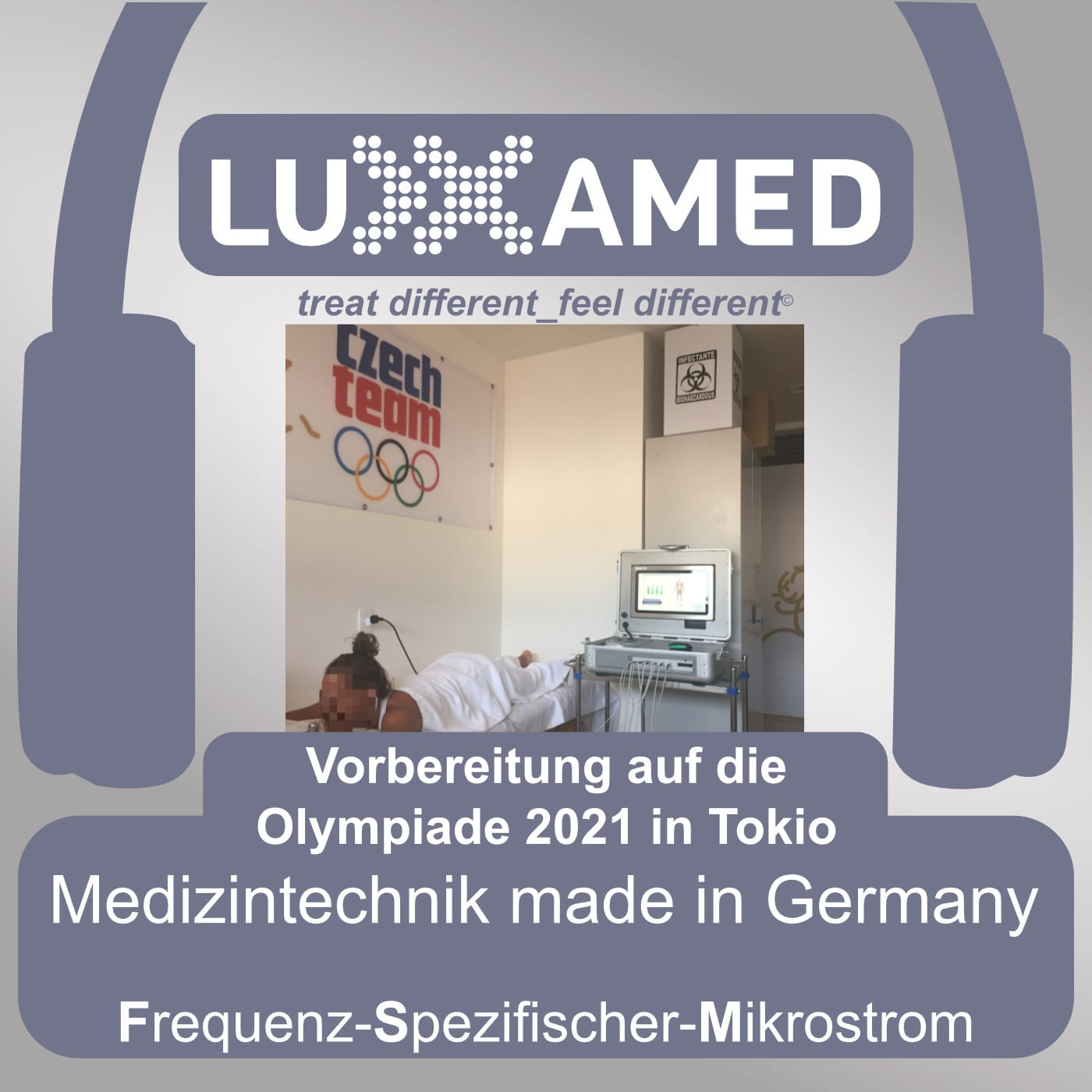
In a few weeks’ time, the 2021 Tokyo Olympics will begin. As was the case at the Games in London and Brazil, LuXXaMed microcurrent will once again be there. Orthopaedic surgeon Dr Vlastimil Voracek, MD, uses microcurrent therapy with the athletes on a daily basis. The focus is, of course, on injuries, but recovery after training and competition also plays a very significant role for him.
As part of a holistic medical approach to therapy, rehabilitation and prevention for elite athletes, microcurrent therapy has been an indispensable part of Dr Voracek’s practice for many years.
However, we also addressed the topic of prevention in relation to sports injuries in this episode. Not least for professional athletes, this is an essential element in ensuring they can deliver maximum performance when it is needed.
Transcript of this episode
00:00:00
Interviewer: Welcome to a new podcast from LuXXaMed GmbH. My name is Patrick Walitschek and, in this episode, I’ve brought you another fascinating interview. In a few weeks’ time, the 2021 Tokyo Olympics will be getting underway, and our Medical Director, the orthopaedic surgeon Dr Voracek, will once again be there at the Olympics – and, of course, LuXXaMed will be there too. We were already represented by LuXXaMed at the Olympics in London and Brazil, and this year we’ll be there again in Tokyo. And I was particularly interested in what the preparations are actually like – in other words, what options are there for using microcurrent in the athletes’ preparation? What does day-to-day life at the Olympics look like? What about injuries?
00:00:49
Interviewer: And, of course, the topic of athletes’ recovery is always very important – so how can athletes recover more quickly after competitions and training sessions, and in what ways can microcurrent also be used here as a preventative measure? Well, it’s an exciting podcast, especially right now given the focus on professional sport and this year’s Olympics in Tokyo. I don’t want to keep you in suspense any longer, so as usual, we’ll check in briefly again at the end of this interview.
00:01:22
Interviewer 2: Hello, Vlastimil! I’m delighted that we’re able to record another new podcast together from the beautiful Allgäu – or rather, is this actually the Allgäu where we are, or is it still on the outskirts of the Allgäu?
00:01:33
Interviewee: No, this is definitely the Allgäu.
00:01:35
Interviewer 2: Where does the Allgäu begin and where does it end?
00:01:39
Interviewee: It’s a fluid boundary!
00:01:43
Interviewer 2: Well, anyway, we can definitely say …
00:01:44
Respondent: But at least the district is Unterallgäu. The Allgäu, I think, is south of the Danube – a bit further south of the Danube. The Iller river forms part of the boundary there – between the Bavarian Allgäu and the Swabian Allgäu – and everything that lies, I’d say, south of the motorway towards Munich and Lindau is definitely the Allgäu. On the Bavarian side, we’ve also got the Unterallgäu. That stretches as far as Krumbach, then it ends there and then… the Allgäu is, more or less, the area from here up to just before Landsberg and Buchloe; then it goes down to Marktoberdorf – all of that is already the Allgäu.
00:02:31
Interviewer 2: Okay. So we can – for someone who lives north of the ‘Weißwurst Equator’ – conclude that we’re definitely in Bavaria.
00:02:39
Interviewee: We definitely are.
00:02:40
Interviewer 2: Okay, very good. Yes, lovely. We’ve got together again today, which I think is great, because there are only a few weeks left until the Tokyo Olympics. And you’ll be taking part again this year – or rather, at these Olympics. I believe you were there in Brazil, and you were in London too – that’s right. And I’d be interested to know what the athletes’ general preparation actually looks like. Of course, also in terms of the use of microcurrent there. But also in general – what do you get up to in the months leading up to the Olympics?
00:03:19
Interviewee: Well, in the months leading up to the Olympics, there’s still the qualification process. That means the qualification process doesn’t finish until the end of June, I think, or early July. So, up until then, all the athletes can still qualify, and there are various European Championships and other competitions still taking place. And people are trying to rack up their points right up to the last moment so they can go to the Olympics. And some of those who’ve already qualified – those who’re 100 per cent through – are, in some cases, taking it easy and just training. And as I said, those who still need a few more qualification points are definitely still out there competing.
00:04:08
Interviewer 2: And what’s the situation from a medical perspective? Are there specific things you do with the athletes?
00:04:16
Interviewee: Let’s put it this way: nothing specific. We’re simply following the very clear programme. After all, the Olympics are ultimately just another competition, just one held under the Olympic rings. And what you, let’s say, plan is that if you have injuries that you know keep coming back, then of course you try to take it easy before the Olympics once you’ve already qualified. And then you just have to tackle those issues very specifically. These are often long-term issues, for which microcurrent therapy is, of course, particularly well-suited. Supplemented, of course, by perhaps a few injection therapies using very specific, shall we say, substances that can be combined very effectively with microcurrent therapy.
00:05:13
Interviewer 2: Well, I mean, injection therapies in particular are, I think, likely to be a problem, especially when it comes to athletes, professional athletes.
00:05:20
Interviewee: Yes. Well, normally at the Olympics there’s a ‘No Needle Policy’. And infusions are problematic anyway; particularly during the Olympics, intravenous administration is restricted to 100 millilitres, or rather, infusions themselves aren’t permitted at all. That means you’re then limited to injections only – you can perform infiltrations, you can inject the tissue, but intravenous treatments are very strictly limited.
00:06:00
Interviewer 2: Okay. And does that offer an advantage for microcurrent therapy in particular when it comes to treating athletes? You’ve just mentioned the issue of long-term problems – let’s call them that for now – injuries, whatever they may be, and how that plays out. In your view, does microcurrent offer an advantage here?
00:06:18
Interviewee: Yes, of course, because we do have the problem of injuries. Particularly with athletes, including slightly older ones, there are often – let’s say – remodelling or adaptation processes in the soft tissues, tendons, capsules and muscles that have previously been injured, as well as scar tissue, which means you have to take a slightly, shall we say, gentle approach here and plan for the long term. That means, if I say, ‘I know I have an Achilles tendon issue’, I can also treat the Achilles tendon. But of course I could, let’s say, ‘overdo it’ with cortisone or similar treatments. Or I can plan ahead and say, ‘We’re aiming for you to be fit in four weeks, or in six weeks.’ In that respect, it does give us certain targets. And then you can work very, very effectively with microcurrent, because thanks to this feedback mechanism and, on the one hand, the measurements we have there and these curve patterns, we can assess very well how the progress is unfolding.
00:07:31
Interviewer 2: Right. I find the topic of goals particularly interesting. I’ve had quite a few discussions with users over the last few days, including on our online forum, and I find the topic of setting goals in therapy absolutely fascinating, just as you’ve just said. In the broader context, relating to athletes, but perhaps let’s… Let’s step away from the topic of athletes and the Olympics for a moment. The topic of setting goals in therapy. How do you approach this in your daily practice? I mean, regardless of microcurrent therapy, just in general.
00:08:04
Interviewee: Well, experience shows us that certain injuries follow a specific timeline, and we know that I can positively influence this through microcurrent therapy. That’s why, based on the initial response when I start treating a patient using microcurrent, I can see how quickly things change, let’s say, or… How quickly is the healing progressing? And we know from earlier times, when I wasn’t using microcurrent, that the timeframes do vary. That means I can set myself a target. I know exactly that if the progress curves are at this point or that point, and the patient gives me this or that feedback, then I know I’m on the right track. And I can say that it won’t take six weeks, but rather three or just four.
00:09:09
Interviewee: And setting this target is very important in the long term, even for the average patient, and we can also say that I can sometimes help with other things as well; I can support the process, whether with medication, injections, or other measures – be it other physical therapies or additional therapeutic interventions that we can offer the patient as part of our range of options.
00:09:44
Interviewer 2: Perhaps just to clarify, in terms of what actually affects the patients – I find that absolutely fascinating, the way you put it. So, as I understand it, you actually discuss the goals with your patients?
00:09:56
Interviewee: Yes, because the patient wants to know how long it will take or what they can expect. And it’s particularly important for athletes, because they have their own plans – which competitions do they want to take part in, where do they want to go? Then, of course, there are sponsors – they have certain contracts too, which means time is absolutely crucial for athletes. For the average patient, time might not be quite such a factor, but even so, they know they’ve got a holiday planned – they’ll ask, ‘Can I go on holiday?’ I mean, that’s a specific goal in itself, and as a result we’re under a bit of pressure to ensure the treatment is successful; patients realise this in advance because they’re wondering: ‘Will I have to cancel my holiday, or can I go after all?’
00:11:00
Interviewer 2: No, it’s also a completely concrete goal for the patient, which is important too. I think that’s my impression of goals in general too – that you naturally try to specify these goals accordingly; it’s a measurable goal: ‘Can I go on holiday, or can’t I?’ I can measure very easily whether I can go there or not. And I think that’s also, in my view, a very important aspect when working with microcurrent therapy, but I believe it applies to many other forms of therapy as well, particularly when we’re talking about therapies that work on a regulatory and regenerative basis, it’s crucial to agree on clear goals, because ultimately, success is, by definition, simply the achievement of a set goal – it doesn’t matter at all what that goal is, whether I manage to move down three, four, five or six points on the visual analogue scale or not – ultimately, it’s all about achieving a goal, and I think the holiday is certainly a concrete goal in its own right. And now, to come back to the athletes. I just wanted to mention this again, because the framework for the goals was quite good; I’d actually love to do a separate episode on that anyway – less in a medical context, and more in a communicative one. But I’d also be interested to hear from the athletes on this topic: how do you incorporate microcurrent therapy? Moving away from trauma treatment and injury management, and looking at the area of – let’s call it – prevention and recovery: what role does microcurrent play for you in this concept, particularly with athletes – let’s say professional athletes and Olympians?
00:12:34
Interviewer: There are two distinct phases: there’s the long-term or chronic phase, or the preparation phase, and then there’s the acute phase. This acute phase arises, for example, when you’re already there a week before the Olympics; you’re training and preparing for the competition – that is, this phase takes place a week before the competition. And the athlete might say, ‘It hurts a bit here’, ‘It’s a bit sore there’, or ‘I’ve got a problem here’, and then, of course, you have to assess specifically whether that’s a case for microcurrent therapy; and if it is, then it’s definitely used.
00:13:16
Interviewer 2: What is the criterion, excuse me?
00:13:19
Interviewee: The criterion – it’s very difficult for me to put that into simple terms. I mean, it comes down to the long-term experience you’ve gained with it, but in any case, the criterion is any soft-tissue damage or any problems that aren’t purely due to motor causes – in other words, neuromotor causes. In other words, if I have overloaded tissue that is put under even more strain during the preparation, then… I know, for example, that a particular issue was already causing him problems before the preparation began; that means I would focus more on that area and ensure these problems don’t arise in the first place. I mentioned the Achilles tendon earlier, for example: I can measure the Achilles tendon again – that’s the advantage.
00:14:19
Interviewee: And based on this particular algorithm that’s generated here, can I assess whether the tendon is fine or not? Do we need to address it? And the athlete doesn’t even need to come in and say that something’s hurting; you simply need to look at the issue from a medical perspective and not wait until the athlete comes in complaining of pain – and that’s where this microcurrent comes in handy. Because if they say, ‘I keep having problems with my shoulder’ – then I’ll treat their shoulder as well; I can treat it physically, I can treat it physiotherapeutically, or with injections if necessary, but microcurrent is a more or less subtle form of ongoing therapy just before a competition; on the one hand, it aids metabolic regeneration – we know it helps a great deal with that – but particularly with these overuse injuries, it’s a very effective way of taking pre-emptive action.
00:15:27
Interviewer 2: When it comes to metabolic regeneration, how do you apply it specifically in that context? What are the …?
00:15:32
Interviewee: Usually after training. Once they’ve had a shower and have time to lie down, that’s when I apply it. And that’s either targeted specifically at a particular organ or applied systemically. And as they’re lying down anyway, reading something, it’s a great time to use it.
00:15:58
Interviewer 2: Do you think that’s precisely because… I mean, it is a very gentle form of therapy, and when they’re lying there – regardless of… As I said, setting injuries aside for a moment. They’re now being treated there for metabolic regeneration, in a systemic setting – just as an example. Do you also think that the microcurrent offers a way of helping the athletes achieve a certain form of ‘switching off’, that is, mental regeneration as well?
00:16:25
Interviewer: I don’t know, I haven’t really tried it yet to see if they can switch off mentally. In any case, they simply find a time when I say, ‘Now you’re going to lie here for an hour,’ and then they sleep or read something. Many read on their mobile phones or something like that, or send messages or check their social media. But overall, I’ve noticed that when an athlete tends to develop problems in certain parts of their body or keeps complaining about them, and I treat those areas with microcurrent after training, these issues either don’t occur in the first place or, at the very least, develop more slowly. And that means, ultimately, that you don’t just win competitions during the competition or training itself, but during recovery. And that’s the crucial factor.
00:17:27
Interviewer 2: Okay. Regarding the injuries, can you be more specific? What sort of injuries are they? More like muscle, soft tissue or tissue injuries, or …?
00:17:32
Interviewee: Well, we don’t need to talk about fractures, because you wouldn’t compete with those. But mostly they’re tendon and muscle injuries, strains – proper injuries in that sense. Well, sometimes they’re also partial tears – muscle fibre tears and attachments. If you’ve got time – say, a week – then you can really get that sort of thing under control with microcurrent therapy, so that the athlete can actually compete again. But otherwise, with more serious injuries, they’re ruled out straight away, logically enough.
00:18:14
Interviewer 2: Well, brilliant. So, to summarise the area of sports injury prevention, or rather preparation for the Olympics or World Championships – it doesn’t matter in what form – that we definitely use microcurrent therapy in the field of post-traumatic treatment, of course, but also for recovery – and I’d actually like to make a distinction here; I’d like to separate recovery from injury prevention.
00:18:43
Interviewee: Well, the thing is, ultimately it’s regeneration or prevention – they’re really… Good regeneration is good prevention. And we also have an osmotic change: we can use the lymphatic drainage, which is integrated here, or the current itself, to improve or help deacidify the tissue, which means achieving homeostasis more quickly. And if I achieve homeostasis more quickly, the tissue regenerates better – or rather, it’s fit for exertion again more quickly. That’s why you do this relatively soon after training, and experience simply shows that we can clearly prepare high-performance athletes – or athletes with critical issues – much better this way.
00:19:52
Interviewer 2: Great. Well, then all we can do is wish you the best of luck for the Olympics.
00:19:56
Interviewee: Thank you, thank you!
00:19:57
Interviewer 2: And above all, a stress-free – or at least reasonably… It won’t be stress-free, but…
00:20:05
Interviewee: Certainly not in Tokyo, because with all the mask-wearing and tests we’ll probably have to go through every day, it’s not going to be much fun – Rio was actually a bit more fun!
00:20:24
Interviewer 2: So it’ll be an exciting challenge?
00:20:26
Interviewee: Exactly.
00:20:27
Interviewer: That was our interview with Dr Voracek, a doctor and orthopaedic surgeon, on preparations for the 2021 Tokyo Olympics and how microcurrent is used – or could be used – there. The interview went on for much longer: we covered two further topics, which will be featured in subsequent episodes. Next week, we’ll be talking specifically about the LuXXaMed HD 2000 Plus and the new software version 3.0, and we’ll hear about his experiences in his private practice on the one hand, but also in his clinic – how he perceives the changes, how he perceives the improvements in performance, and so on. So that will be covered in the next episode, and in the one after that – I can already announce this – we’ll be discussing the topic of post-Covid applications once again: specifically, how can microcurrent be used to address post-Covid issues? He gave an interview on this subject to Czech state television – or rather, it was filmed at his clinic in the Czech Republic, where a patient also had his say and shared his experiences on the matter. So, the next episodes are all set – it’s going to stay exciting, and I’d like to thank you for listening, for tuning in, and as always: please give us five stars on iTunes, and be sure to subscribe, no matter where you listen to us. If you’re listening on YouTube, please subscribe to our channel: We don’t just post audio content there – we also put out video content from time to time. So, if you have any questions or would like to share feedback, or if you have any topic requests or ideas, please do get in touch – we’d love to hear from you. On that note, thanks again and see you in the next episode!