LuXXaMed Microcurrent and Cell Regulation
Fraunhofer Institute study on the influence of microcurrent on cellular metabolism
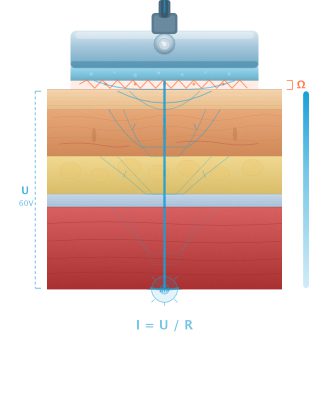
The LuXXaMed uses frequency-specific microcurrent to influence cellular metabolism in tissue. A study by the Fraunhofer Institute FEP for Plasma and Beam Technology demonstrated the effects of the frequency-specific microcurrent from the LuXXaMed HD2000+ on human fibroblasts and keratinocytes.
As early as 2015, the Fraunhofer Institute investigated the effects of the LuXXaMed’s LED light therapy. Human cell cultures (fibroblasts and keratinocytes) were also used in this series of experiments. Among other things, the study examined the effect of increased intracellular ATP (adenosine triphosphate). The increase in ATP regeneration is a much-discussed topic in relation to microcurrent. “Adenosine triphosphate is the universal and immediately available energy carrier in cells and an important regulator of energy-supplying processes.” (Wikipedia, 2002)

In the study of LED light therapy (exclusively using LuXXaMed LED light without the use of microcurrent), an increase in ATP and an effect on cell vitality were demonstrated. “… an increase in intracellular ATP concentration, a significant rise in metabolic activity and an improvement in cell vitality…” (Karutz, 2012, II)
This article is also available as a podcast!
You are currently viewing a placeholder content from Default. To access the actual content, click the button below. Please note that doing so will share data with third-party providers.
More InformationRecent study on the effect of LuXXaMed’s microcurrent on cell regulation
Research question: How can the frequency-specific microcurrent be introduced into the cell cultures?
The study design presented an initial challenge. The problem here was that we had to attempt to introduce the microcurrent into the cell cultures without distorting the frequencies on the one hand, and without affecting the resistances on the other.
An initial attempt to channel the frequency-specific microcurrent into the cultures using Petri dishes fitted with gold contacts failed. The reason for this was that even a current as weak as the microcurrent triggered electrolysis, which damaged the cells. Consequently, a different setup had to be chosen.
Taking into account the risk of bacterial contamination of the cell cultures, an experimental setup was developed in which the frequency-specific microcurrent was conducted into the cultures via an agar bridge. The agar bridge offered the advantage that neither the frequencies nor the resistance were affected.

Objective of the application using frequency-specific microcurrent
The aim of the study was to provide valid evidence that the frequency-specific microcurrent from the LuXXaMed is indeed capable of regulating cell metabolism. Microcurrent is generally said to be equivalent to biological cell regulation, without, unlike classical electrotherapy, influencing conduction processes in the tissue. The effect can be understood as follows: on the one hand, the specific frequencies transmitted via the microcurrent are intended to influence both the state and the function of the cells; and on the other hand, the membrane potential is altered via the actual current strength and the underlying technical direction of current flow (polarity of the microcurrent).

Summary of the study’s findings
- Metabolic activity can be demonstrably increased through the use of the LuXXaMed HD2000+. Human keratinocytes were observed which had previously been damaged with cycloheximide. This was intended to achieve a reduction in metabolic activity of 20–30 per cent. Treatment of the damaged cells showed an increase in metabolic activity of up to 56 per cent compared with the untreated control. (Schönfelder, Walker & Kenner, 2017, p. 15)
- When examining the treatment of viable keratinocytes, it was found that the use of the HD2000+ can lead to an increase in viable cells of up to 48 per cent. In the case of diseased or pre-damaged cells, a reduction in apoptotic and necrotic cells of up to 12 per cent was observed. (Schönfelder et al., 2017, p. 17)
- Schönfelder et al. (2017) demonstrated in an in vitro study using human cell cultures that a change in cell morphology can be observed. “This proves that the applied current – including the microcurrent of the HD2000+ – reaches the cells and is capable of influencing them.” (Schönfelder et al., 2017, p. 11)
- The in vitro study by the Fraunhofer Institute showed that the microcurrent of the HD2000+ does not lead to any changes in the cell cycle profile. It can therefore be concluded that the use of the HD2000+ does not result in cell degeneration. (Schönfelder et al., 2017, p. 17)
- A fluorescence microscopy examination of the cells treated with the HD2000+, when compared with the control, showed that the cells exhibited good adhesion and spreading. It can therefore be concluded that the cell population in the study cited here is ‘healthy’. (Schönfelder et al., 2017, p. 19)
Sources
Karutz, A. (2012). Determination of the influence of nanophotonics technology on in vitro cell cultures. Master’s thesis. International University Institute Zittau, Zittau.
Schönfelder, J., Walker, S. & Kenner, L. (2017). Effect of a new generation of devices on in vitro cell cultures. AP 3: Effect of microcurrent therapy on in vitro cell cultures (Fraunhofer FEP, ed.).
Wikipedia. (2002). Adenosine triphosphate. Accessed on 22 October 2019. Available at https://de.wikipedia.org/wiki/Adenosintriphosphat