Microcurrent in rehabilitation following total knee replacement: What two clinical studies relating to the LuXXaMed range of devices really show
Rehabilitation following total knee replacement is about far more than just joint mobility. Of course, flexion, extension and gait play an important role. In everyday clinical practice, however, the success of rehabilitation often hinges on other factors: early pain management, functional capacity in daily life, the patient’s active participation, and the question of how quickly a surgically treated knee can once again be safely and meaningfully loaded.
This is precisely where microcurrent becomes an interesting adjunctive measure. Not as a substitute for structured rehabilitation, but as a potential addition within an already functioning rehabilitation programme.
Two studies in particular are relevant to this article, as they relate directly to the predecessor line of LuXXaMed products and the family of devices used, respectively. The study with the stronger methodological rigour was conducted by Rockstroh, Schleicher and Krummenauer in 2010. It was carried out using intervention and sham treatment devices provided free of charge by Walitschek Medizintechnik GmbH. The second study, by Orfei and colleagues from 2016, describes a clinical observational study involving additional BCR microcurrent therapy using LuXXaMed HD3000 devices. Luxxamed explicitly classifies the Rockstroh study as one using LuXXaMed’s predecessor device and the Orfei study as one on BCR microcurrent therapy following knee replacement surgery.
Why rehabilitation following knee TEP is a critical window of opportunity
The early phase following knee TEP is clinically crucial. During this period, post-operative pain, soft-tissue irritation, swelling, muscular inhibition and uncertainty regarding movement patterns all converge. If the pain burden remains too high during this phase, the quality of active rehabilitation often suffers. Patients move less effectively, exercise more cautiously, develop compensatory movement patterns and often lose valuable time at a stage when progression is actually required.
This is precisely why approaches that do not merely show a potential effect ‘at some point later’, but could make a difference early on in the rehabilitation process, are of particular interest.
The key study: Rockstroh et al. 2010
The Rockstroh study provides the strongest clinical evidence for this topic. It was a randomised, controlled trial with patient-blinded design. A total of 78 in-patient patients following total knee replacement were evaluated over a three-month period. All patients received standardised follow-up treatment. The intervention group additionally received ten sessions of microcurrent therapy, whilst the control group received a sham treatment using an identical device following the same protocol. The primary endpoint was defined as the change over three months in an OSWESTRY-based functional score; secondary endpoints were the WOMAC index and the Visual Analogue Scale for pain.
Methodologically, this is significant because the study did not compare microcurrent with ‘nothing’, but rather microcurrent plus standard rehabilitation with standard rehabilitation plus a sham treatment. This addresses the clinically much more relevant question: does microcurrent provide additional benefit within a rehabilitation programme that already adheres closely to guidelines?
The study also describes the therapeutic basis in great detail. During the three-week AHB, both groups received standardised physiotherapy comprising physical therapy, gait training, joint replacement group sessions, occupational therapy, pedal cranks training, medical exercise therapy, compresses and, where necessary, a motion splint. Microcurrent treatment began on the second day of the AHB, lasted 40 minutes daily and was carried out using the CE-certified Clinic-Master Professional (medical device). Programmes such as those for inflammation, pain and scar treatment were used based on the patients’ clinical findings. The frequencies varied between 0.4 and 400 hertz.
The functional outcomes
The primary endpoint was clearly in favour of the microcurrent group. The OSWESTRY-based benefit score rose in the intervention group by a median of 31 per cent, from 53 per cent to 91 per cent. In the control group, it rose from 56 per cent to 78 per cent, an increase of 18 per cent. This difference was statistically significant. In addition, 73 per cent of patients treated with microcurrent achieved an increase in benefit of at least 25 per cent, compared with 37 per cent in the control group.
This is not merely an academic distinction. Translated into practical terms, this means that, after three months, patients in the microcurrent group were functionally further along in their daily lives. This is clinically relevant for rehabilitation, safety in daily life and subjective resilience.
The WOMAC data
The WOMAC results also painted a consistent picture. The microcurrent group showed a median improvement from 56 per cent to 94 per cent – an increase of 35 per cent. The control group improved from 58 per cent to 82 per cent, an increase of 18 per cent. It is particularly interesting that, after just five treatment sessions, the intervention group showed a median WOMAC increase of 21 per cent, whilst the control group had achieved only 3 per cent at that stage.
It is precisely this early difference that is therapeutically significant. This is because if a patient makes faster functional progress in the initial phase of rehabilitation, this usually improves not just a single measurement but the overall dynamics of the rehabilitation process.
Pain scores
The pain trajectories also point to an early effect. After just five treatment sessions, patients in the microcurrent group reported a median reduction in pain of two VAS points, from 4 to 2. The control group showed no significant median improvement at this stage. At the three-month follow-up, the control group was still at 2 VAS points, whilst the microcurrent group was, on a median basis, pain-free.
This is highly relevant in clinical practice. Earlier pain reduction often means better mobilisation, greater patient cooperation, less protective muscle tension and more stable confidence in the operated joint.
The supplementary study: Orfei et al. 2016
The Orfei study is methodologically weaker but very valuable in terms of content. It investigates pain management during the rehabilitation phase following knee replacement surgery as part of a clinical observational study with open patient recruitment. The study included 30 patients who were transferred to an intensive rehabilitation programme after surgery and received physiotherapy there for at least three hours a day over a period of two weeks. The second group additionally received ten daily sessions of biological cell regulation using microcurrent, with devices from the LuXXaMed HD3000 range. Assessment was carried out using the VAS and the Knee Pain Scale on the second post-operative day, after ten therapy sessions, and approximately 30 days later.
The baseline values in the standard group were a VAS of 5.42 and a Knee Pain Scale score of 42.85. In the BCR group, they were a VAS of 5.7 and a Knee Pain Scale score of 60. After ten rehabilitation sessions, the standard group achieved a VAS score of 2.8 and a Knee Pain Scale score of 26.42. The BCR group achieved a VAS score of 2.1 and a Knee Pain Scale score of 22. After around thirty days, the groups had largely converged: Group A at a VAS of 1.9 and a Knee Pain Scale score of 20.18, and Group B at a VAS of 1.8 and a Knee Pain Scale score of 20.11. The authors conclude that BCR using microcurrent can contribute to better and earlier pain control during the rehabilitation programme.
What do these two studies mean taken together?
Taken together, both studies paint a consistent picture, albeit with differing levels of scientific rigour.
The Rockstroh study is the methodologically stronger piece of work. It provides the most robust evidence that microcurrent, as an add-on to standard rehabilitation following knee TEP, can achieve functional benefits and greater pain reduction.
The Orfei study complements this picture. It is not a randomised, sham-controlled trial, but an open-label observational study. Consequently, it carries less evidential weight. Its value lies primarily in the fact that it supports the hypothesis of earlier pain control during the intensive rehabilitation phase.
To put it another way: Rockstroh’s study provides stronger evidence for function and recovery. Orfei’s study provides stronger evidence for early pain modulation.
How does this topic fit into the wider context?
The internal LuXXaMed summary classifies microcurrent fundamentally as electrotherapy in the microampere range and clearly distinguishes it from more current-based methods such as TENS or conventional stimulation therapy. At the same time, it emphasises that the primary focus is not on pain gate control, but on the regulation of metabolic processes.
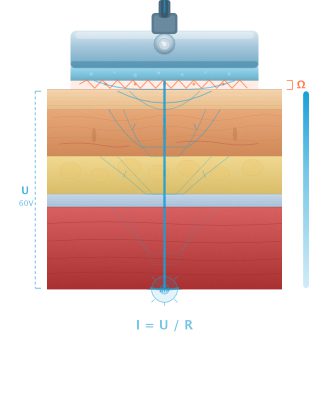
In the LuXXaMed fundamentals, too, microcurrent is not described as a one-dimensional frequency-based concept, but as the interplay of several active parameters. These include current strength, voltage, frequency and the polarity of the square-wave signal. The document also notes that Cheng et al. demonstrated in a laboratory experiment that currents of up to 500 µA can increase ATP production, membrane transport and protein synthesis. At the same time, it is expressly made clear that no unsound exaggerations should be derived from this in vitro work.
This qualification is important. This is because, particularly when it comes to post-operative issues, there is a risk of hastily deriving therapeutic certainties from plausible biophysical mechanisms. The responsible approach is therefore: biologically plausible, clinically interesting, but always to be interpreted within the context of the specific study design.
What does this mean in practice?
For therapists and doctors, a number of clear conclusions can be drawn from these data.
Firstly: in this context, microcurrent is no substitute for rehabilitation. In both studies, standardised physiotherapy remained the foundation; microcurrent was used as an adjunct.
Secondly: the potential benefit appears to lie particularly where early pain control and functional progress influence the course of recovery. This is especially relevant in a therapeutic context following total knee replacement, as pain and uncertainty are often direct barriers to active rehabilitation.
Thirdly: The strongest argument for everyday clinical practice is not that ‘microcurrent heals faster’, but rather that ‘within a structured rehabilitation programme, microcurrent may help to reduce pain sooner and support functional progress’. This is scientifically sounder and much more robust from a communication perspective.
Regulatory and communicative context
Restraint is essential when communicating externally. The LuXXaMed therapy instructions expressly state that any statements do not constitute a promise of a cure and that the effectiveness of the therapies and procedures described cannot be guaranteed under any circumstances. Furthermore, it is emphasised that professional users must comply with the regulatory requirements of the MPBetreibV when using the device.
Conclusion
Rehabilitation following knee TEP is a complex process in which pain, function, load-bearing capacity and active patient participation are closely interlinked. This is precisely why complementary procedures are of interest, provided they are not considered in isolation but are meaningfully integrated into an active rehabilitation programme.
The Rockstroh study provides the strongest evidence that microcurrent, when used as an adjunct to standard rehabilitation following knee TEP, can yield functional benefits and a more significant reduction in pain. The Orfei study complements this perspective with indications of earlier pain control during the rehabilitation phase. Taken together, both studies suggest that microcurrent should be taken seriously in this setting — not as a substitute therapy, but as a potential additional tool within a well-structured rehabilitation programme.
References
Rockstroh, G., Schleicher, W., & Krummenauer, F. (2010). The benefits of microcurrent therapy administered during inpatient follow-up treatment in patients following total knee arthroplasty – a randomised clinical trial. Die Rehabilitation, 49(3), 173–179. https://doi.org/10.1055/s-0029-1246152
Orfei, M., Alunni Ciubini, L., Baci Paci, S., & Guglielmi, A. (2016). Pain management during the rehabilitation phase following total knee replacement: efficacy of biological cell regulation therapy (BCR) using microcurrent. Casa di Cura Liotti S.p.A., Perugia.
Patrick Walitschek, MSc. (2024). Scientific evidence on the effects of LuXXaMed microcurrent devices based on a literature review and the synthesis of 21 studies. LuXXaMed GmbH.
Patrick Walitschek, MSc. (2023). Therapy guide – Guidance on the HD2000+. LuXXaMed GmbH.