Alternative practitioner Burkhard Hock on microcurrent therapy: Part 1/2 + Part 2/2
Interview on 18 years’ experience with microcurrent
You are currently viewing a placeholder content from Default. To access the actual content, click the button below. Please note that doing so will share data with third-party providers.
More InformationYou are currently viewing a placeholder content from Default. To access the actual content, click the button below. Please note that doing so will share data with third-party providers.
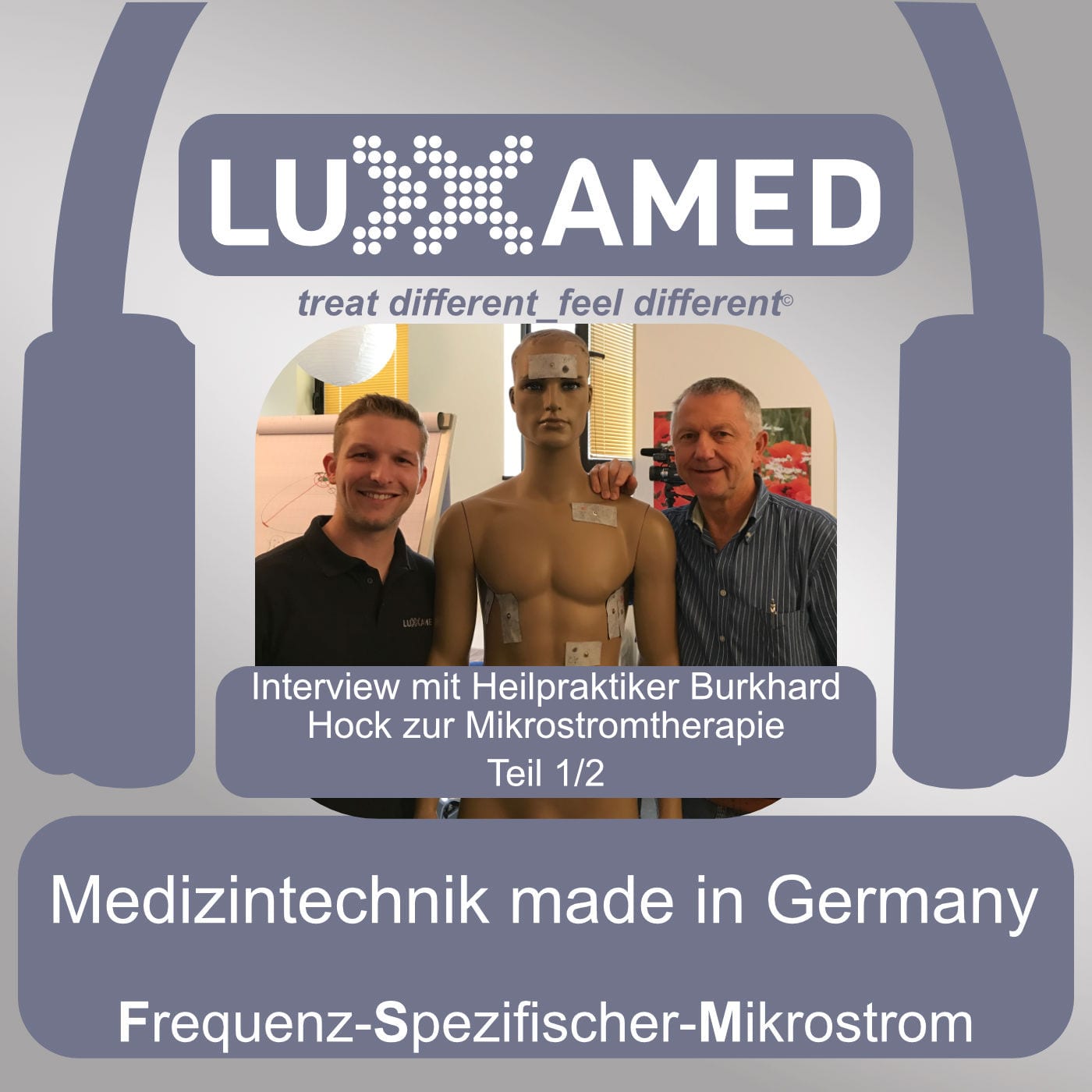
More InformationAlternative practitioner Burkhard Hock has been practising for 30 years, has been using microcurrent therapy for 18 years, is the founder of the Hock Pain Therapy method and a successful author. In this episode, we interview him about his experiences with frequency-specific microcurrent and what he considers to be its main and most successful areas of application. Mr Hock himself cites a success rate of over 95 per cent in the use of microcurrent and certainly takes an unconventional approach to therapy.
Yet his track record of success over an 18-year period proves him right. HP Hock has a wealth of experience, particularly with orthopaedic conditions, and his meticulous approach, combined with his background in electrical engineering, has helped him build up a database of over 38,000 treatments from his 30 years as a naturopath.
“When every movement is accompanied by excruciating back pain, when osteoarthritis in the joints makes even simple tasks difficult – when there’s a throbbing in your head, a pulling sensation in your legs, a throbbing in your fingers, and so on – you want nothing more than to finally be free of these symptoms. You can achieve this with this therapy. I have developed it in close collaboration with university professors, radiologists, physiotherapists and orthopaedic surgeons, and have continually refined it, so that today almost all types of pain can be treated manually with great success.” (www.heilpraktiker-hock.de)
– You’ll be surprised by what alternative practitioner Burkhard Hock has to say about microcurrent therapy. This interview is split into two parts, and you’ll get the second part in the next episode! –
Tip!
Atlas of Pain Therapy by alternative practitioner Burkhard Hock
Transcript of the full interview with alternative practitioner Burkhard Hock
00:00:00
Interviewer: Right then, a warm welcome to the new podcast. I’m back in the beautiful Berchtesgadener Land today, visiting naturopath Burkhard Hock, and I’d like to say: Thank you very much, Burkhard, for having me here, and I’m looking forward to our conversation now!
00:00:13
Mr Hock: Yes, thank you for letting me take part in this podcast. And yes, I’m delighted too. I’ve been looking forward to seeing you again all this time and simply having a bit of a chat about our field with you, yes.
00:00:30
Interviewer: Great. What shall we talk about today? I think what interests a lot of people, first and foremost, is naturally the topic of microcurrent therapy in practice in general, but I believe you’re no stranger in Germany either – thanks to your work, your therapies and your many training courses and seminars, and of course not least through the books you’ve written, and in which you really do pass on phenomenal knowledge in written form – and I think these are definitely topics that interest the people listening to the podcast. But perhaps to start with, just a bit about yourself: how long have you been doing all this now? How long have you been at home in the world of therapy?
00:01:14
Mr Hock: Well, in two months’ time I’ll be celebrating my 30th anniversary – I’ve been practising as a naturopath for 30 years now, and I’ve been working with microcurrent for 18 years. I started out with the Vital-Masters and I still have plenty of them, simply because I use this medium to make things easier for patients who come from far away… These devices have been to Canada, they’ve been to South Africa too, and yes, it’s simply wonderful to see how you can ultimately work successfully with minimal effort. And I’m a huge fan – as you know – of microcurrent therapy. And every day I witness miracles, you could say, when you consider that patients who, for example, have had a brain haemorrhage or who simply received a very poor prognosis from their cancer treatment during their examination and then underwent surgery and are actually no longer functioning properly – let’s put it that way – and it’s a dream come true when you can help someone like that. And yes, I’m an electrical engineer, and from that perspective you know that I think a little differently when it comes to microcurrent, that my set-ups look a bit different from the ones you’re used to…
00:02:47
Interviewer: The traditional ones?
00:02:47
Mr Hock: …the classic, practical set-ups. But we touched on this briefly earlier: with the LuXXaMed – when I see it, I’ve absolutely fallen in love with the post-operative programme: Well, when someone’s actually had an operation and so on, just how quickly you can get them back on their feet with this programme – you can’t even imagine it. When people come into the practice, they’re as white as a sheet, they’re practically on the verge of collapsing – it’s so obvious – and their heart’s racing, but otherwise they’ve completely lost their zest for life. Then, with the detox and post-operative care, this combination straight after the operation – it’s simply a brilliant, brilliant, brilliant thing: Even after 30 years, that still does me a world of good as a therapist, because conventional medicine, I believe, can’t offer that, because the foundation – and I do train conventional doctors, mind you – and when I see that they’re no longer being trained in the fundamentals, but are simply being guided towards surgical techniques. And when I see orthopaedic surgeons coming to me who can’t even test a hip joint, and then ask – or say to me – when I say: ‘Have a go at testing that hip joint to see if it’s still all right’, and they reply: ‘Yes, if you show me how to do it, then I’ll do it.’ – well, that does make me feel a bit odd, seeing how things have developed over the years. And we’re moving further and further away from person-centred therapy and increasingly towards machine-based medicine and ever more technology. And although I now have a device in the form of the LuXXaMed, I also have a current that everyone carries within them. Well, we function on direct current, and we function on that energy, and if we can make use of it – it’s a tool that’s phenomenally good – that’s probably why I have such an affinity for it, so that I simply say: ‘Yes, we have to do something about that.’
00:05:06
Interviewer: And how do you go about it, purely from a practical point of view? Are there criteria for you where you say, ‘Here comes a patient with problem XY’ – which, let’s say, doesn’t really matter at this stage – but is there some sort of framework you follow where you say, ‘I’ll use this explicitly for these patients or these specific issues’? Or how do you generally go about managing it, so to speak, in simple terms?
00:05:31
Mr Hock: Well, as you know, my main specialism is orthopaedics, and I’ve actually developed my own method for pain management, which isn’t about the pain itself, but rather focuses on this question: Are there any movements that cause pain? And once I know which movement causes the pain, I’ve got straight to the root cause, and that’s the angle I work from. When it comes to joint problems or the like, I don’t use microcurrent much, because with the method I’ve developed, I’m simply very quick to get to the root of the problem by analysing the movement. So, I don’t have to guess or say ‘it could be this’ or ‘maybe that’ – with my approach – and this might sound a bit arrogant – but I get to the root cause very, very quickly, let’s put it that way. But if a patient comes in who’s had any sort of operation – whether they’re having a knee joint fitted, a new one, that is, a replacement joint, or a hip joint, or have had an operation somewhere else, let’s say they have breast cancer or some sort of liver problem, or whatever, or even a brain haemorrhage, an angioma or something like that – in the end, I just use microphones. So, I simply use this tool and can use it in such a way that I can reach everywhere. And I’ve just had a Parkinson’s patient, and that’s another instance where persuasion is key – something you have to do as a therapist. Because I once had a Parkinson’s patient; I carried out three treatment sessions with him and it didn’t help at all, but what emerged was this: I simply left his hair as it was and then, in the end, tried to treat him through it, and that didn’t work. And the patient I’m treating now – well, it’s a learning experience; I’m still learning too – so I went up to him and said: ‘I can only work with you – work successfully – if you shave your head. And that didn’t bother him at all. He said: ‘We’ll wait a bit longer until it’s a bit warmer.’ And then, four weeks ago, he came in for the first time and was completely bald. So, of course, I was able to work wonderfully with my electrodes on him, and the result is good. Now, we haven’t had a huge success yet with the three treatments we’ve carried out so far. However, we’ve reached the point where he’s no longer shaking the day after treatment – everything’s calm, and that’s already a very good result for the patient too. Because you have to think of it like this: when you’ve been walking around your whole life unable to make any normal movements at all, and then suddenly you receive an electrical treatment, the question doesn’t immediately arise – does it help or doesn’t it? – because nobody knows how it actually works at that moment, and then when the patient suddenly says, when they come back for the second time: “It was really easy last time. It was like this: I was so calm and I was able to make movements that I haven’t been able to do so calmly for ages.” And I’m genuinely happy for the patient.
00:09:19
Interviewer: Yes, brilliant. But, if I’ve got it right – also from the seminars we did together, or rather that you ran, on the subject of microcurrent, where the focus was actually less on the therapy itself and more on the application techniques – the biggest questions users often have – but I know you’re generally very successful with microcurrent in internal medicine as well – that is, alongside the orthopaedic cases you treat with manual therapy. Because I remember an example you always mention at the seminar, about the asthma patient, the young boy – yes, the one where it worked very well.
00:09:52
Mr Hock: Yes, the good thing about that story was – and that’s why I got myself a microcurrent device in the first place: because if that boy with asthma had come to me before I had microcurrent, I would have had to say, ‘I can’t help you.’ And if someone came to me who’d had an operation somewhere and was in a really poor state, I couldn’t really help them. And that was, in fact, the reason why I got the microcurrent in the first place. And then, as it happens, fate played a very positive part – or rather, things fell into place for me, you might say. And this ‘falling into place’ meant that I had two patients whom I was able to treat straight away, and where the success of the treatment was verified by conventional medicine. And that was the child you just mentioned: he came to me at the age of nine, had a lung capacity of 65 per cent, and I treated him once a week – or I can’t quite remember exactly, as it was many years ago. But it may also be that we did two sessions at the start. In any case, the mother always went to the paediatrician after two sessions and had a lung function test carried out on the child. And after six sessions, his lung function had improved to 105 per cent, which was, of course, brilliant. And the parents said: ‘We want to carry on with the sessions so that, ultimately, we can be sure it won’t relapse so quickly.’ And this child – it’s important to note – when you’re functioning at 65 per cent lung capacity: you can’t do any sport anymore, and you’re inattentive because you’re not getting enough oxygen. At school and in their whole environment, everything was practically turned upside down. Even within the family itself, due to uncertainty about how to proceed, there simply wasn’t agreement on the way forward; but once we’d completed these six treatments – the child’s lung capacity was then at 105 per cent – and suddenly the child started playing sport again. He caught up at school, even became top of the class and was class representative; before that, they’d been bullying him because he simply couldn’t do anything anymore. Children – as you know – can be very cruel in the way they treat one another, and then suddenly the family was back on track; I think that took about three months, and then the situation turned completely around – more or less into the opposite. Then the paediatrician came and said to the parents: “What on earth have you been doing?” Because by the end we’d reached 120 per cent lung capacity, and the paediatrician said to the parents: ‘I haven’t prescribed a single medication for your child – what on earth have you done to make things turn out so positively?’ And then they just said that they’d been coming to me for treatment, and then: ‘What on earth does he do there? And of course, microcurrent and all that: what on earth is microcurrent?’ And then the parents said: “Why don’t you go and see Mr Hock? He’ll certainly explain it to you, because as we know him, he’s completely open – even towards conventional doctors – about sharing this sort of thing, and I would have been too, but no one’s been there since.” And the second example, where we had the opportunity to prove the effectiveness of microcurrent within the context of conventional medicine – you could say that – was this: a man came to see me and, whilst I was filling in his medical record, I asked him what his profession was, and he said to me: “Go on, have a guess!” So I guessed three different professions and he wasn’t one of them – he didn’t tell me. And then I said to him: “You know, as far as I’m concerned, you can have whatever job you like, because I’m not interested in that at all – we’re here to work now.” He’d come in with a shoulder problem – and after two treatments – he was able to move without pain. And then he said to me: “Can you help me with my prostate problem as well?” So I asked him what the problem was, and he explained that his urologist had been monitoring and assessing his prostate values for ten years; whilst we know these aren’t really meaningful now, they’re still a parameter. And then he asked me – he had a very high PSA level, well into the dark red range – whether we could do anything about it. I didn’t have the experience back then, so I explained the situation to him. I said to him: “Normally, the philosophy behind the current therapy isn’t based on any specific indication, but rather it always asks: ‘Are there cells that aren’t being properly nourished and therefore aren’t being properly stimulated?’ And normally, it should work.” And then he said: “Yes, how often would we need to treat him?” And after he’d told me: “This has been monitored for ten years now,” I set out a rather bold course of treatment, which was as follows: five sessions – one every month. At first he was – just like I probably would have been – a bit taken aback that it would take so long, but then he went along with it and agreed, and I treated him. I performed a prostate treatment, treated him on an organ-specific basis and so on, and after the first treatment he made an appointment with his urologist for a check-up – five months later. So, after five months, he went to see his urologist, had a blood test, met up with him a few days later to discuss the results, and then the urologist said to him: “What on earth have you been doing? Your level is 4.8.” And it had previously been almost ten times that. Yes, and then he said: “Well, I’ve been seeing Hock.” “Oh, what does he do?” “Microcurrent therapy.” And the urologist said to him: “Well, if you believe in that sort of thing, then perhaps it might help.” Yes, and then this good man said to me: “But I want to get into the green zone – that means below three.” And then I suggested to him: “Let’s do two more treatments – again a month apart.” We did two treatments – he had his appointment with the urologist right at the start. He went back to the urologist to discuss the result, and then the urologist said to him: ‘Are you still doing the squats?’ And then he said: ‘Yes, I’m still doing the squats. ‘Why?’ And he said: ‘You’re at 2.3 now.’ And then the urologist said to him: ‘Well, he must know something that neither of us has a clue about.’ And then it clicked in my head, and I said to him, “Don’t tell me you’re a doctor!” And he said, “Yes, I’m a doctor.” And those are the sort of incidents that simply happened right at the very beginning. Of course, they’ve really stuck in my mind in a positive way, because you know yourself what it’s like when you go somewhere for treatment and then people say: ‘Well, it could have been this, or it could have been that, or it could have been the other thing.’ And often, the success of a treatment is talked down to, simply because people might not want the other person to succeed, or whatever – because, at the end of the day, there’s also a bit of resentment and envy involved, if you like. Yes, and in this case, quite simply, nothing else was done. With the child – as I mentioned earlier, this is how it was: he only went there for a check-up. He didn’t receive any other treatment. No medication was given – nothing at all. We just used microcurrent therapy, and did exactly the same with that good man and his PSA level. And that’s simply phenomenal.
00:18:43
Interviewer: Yes, cases like that are, of course, always top-notch – I mean, that goes without saying. And, logically, they naturally shape the whole picture of the therapy.
00:18:55
Mr Hock: Patrick, but the fact is that, ultimately, this isn’t just an isolated case. In the 18 years I’ve been doing this, I’ve perhaps said five times: ‘I can’t help you there.’ So, we haven’t achieved a truly lasting improvement. It wasn’t just five times – that’s the beauty of it. That’s what makes it so interesting – constantly looking at: what’s the matter with this person, what’s the matter with that person, and so on. And I mean, I can admit it now: I have a sister-in-law who has problems with her knee, and I couldn’t help her. Every therapist says they can’t help her with that. She’s just had surgery on her meniscus this week. So, there are cases where you simply have to say it isn’t working. But when I look at the big picture, a success rate of – let’s say – 95 per cent is quite normal, where you see really significant improvements, and that includes some really tough cases – for example, as I mentioned earlier, with that angioma: There’s a man who quite simply suffered brain haemorrhages. They opened up the top of his skull; right at the back of his cervical spine, it was already completely engorged with blood – massive problems: he could no longer speak, couldn’t keep his balance – he couldn’t do anything anymore! Speaking was such an ordeal for the poor man; it was really awful for him and, of course, for those listening too, because ultimately we’d remembered him as being completely different. Well, I knew him very well – that person – and I was involved in his detoxification, detoxification, detoxification, post-operatively, that is. And he’s now got his driving licence back – he’s driving again, he’s cycling again. He’s starting work at the surgery again, and it’s just such simple things – when you see something like that, it just warms your heart to see how you can help in that way. And the attending doctors – they were all amazed at the start, when we began, at the speed of his progress – it’s nothing but positive. Yes, and as for me: Two years ago, I wanted to go on a bike tour in the Bernese Oberland – we were planning to climb three four-thousand-metre peaks, and we were at the start of the Mönch route when I slipped sideways with my crampons on and tore my syndesmotic ligament, and then I was carried back down into the valley. At the orthopaedic surgeon’s, they took an X-ray, and there was a bit of a funny moment because she couldn’t imagine that a naturopath could diagnose whether the syndesmotic ligament was torn. And then they sat me down in a room with a screen, and she said: ‘I’ll be right with you. Your scan’s already on the screen.’ Then she came in and said: ‘And how are you feeling?’ So I said to her: ‘Rubbish.’ And then she said: ‘Why?’ And I said: “Because my syndesmotic ligament’s torn.” And she said: “How do you know that?” And I said to her: “Just look at the screen – you can see for yourself that it’s torn.” And then she looked at it and said: “Now tell me – are you a colleague of mine?” And I said: “No, I’m a naturopath.” And she couldn’t believe that naturopaths in Germany know or can tell whether the syndesmotic ligament is intact or torn. She then wanted me to stay there, in the hospital, and I said: “No, just give me a bandage,” and so I drove home and went to see one of my students, who’s an orthopaedic surgeon. So I went there, and she said to me: ‘Well, you’ll just have to get used to the fact that you’ll be out of action for about four to six weeks.’ And what did Burkhard do? I then – well, let’s say – definitely 18 hours of microcurrent therapy all night long… Well, I couldn’t lie down anyway – every single movement in my foot was painful – so I basically set up a continuous treatment: I pulled a knee-high stocking over it and just stimulated it with electricity. So, a week later I went to see the orthopaedic specialist without my walking sticks and walked up the stairs to the second floor, into her surgery, and then they all looked at me as if I were an alien. And then she said: ‘I know you work with microcurrent,’ she said, ‘but I wouldn’t have believed it.’ And I walked out completely pain-free and was back in the surgery on the ninth day, working as normal – thanks to microcurrent. So, it’s not just that I can help other people, but I can help myself too – that’s brilliant! And there’s a saying – and my secretary knows it too: if Burkhard ever really does stop working – I’ve actually been retired for a few years now, and I’m already receiving my pension – but if I ever do stop: this device is definitely coming home with me! Yes, that’s true, it really is. Because it’s – you could almost say – like life insurance, sort of, because when you’ve got a device like this, it’s quite simply brilliant – it’s nothing but good. So, I’m absolutely delighted that I got to know you – you know, that we’ve been working together successfully for so many years now, because it’s simply lovely, lovely in every way!
00:25:05
Interviewer: I’m really pleased too, absolutely. Hopefully we’ll be able to hold a proper seminar again soon under normal circumstances. I think so, because they’ve always gone down really well. The feedback has always been really, really good.
00:25:22
Mr Hock: We ran a seminar last year, and we’re currently putting off several full seminars, pushing them back by about three months at a time, and then we start postponing them again, and so on. Generally speaking, people are understanding, but it’s still a really awkward situation for us.
00:25:41
Interviewer: But perhaps back to that – not so much the seminars this time – but perhaps also about your books: How many books have you written? Is it four or five?
00:25:50
Mr Hock: Yes, I’ve written five books: firstly, the *Atlas of Pain Therapy*, and then *The Orthopaedic First-Aid Kit* – these are three volumes, each with over 1,200 pages. And then I’ve also written: *‘Does It Still Hurt, or Are You Stretching Yet?’* It’s essentially a guide to stretching, where you’ll find practical stretching exercises that really do help, quite simply, whilst you’re at work. Some of these exercises are also included in the Atlas and in *The Orthopaedic First-Aid Kit* – but with those formats, if you lay the Atlas on the floor and want to do the exercises next to it, it’s a bit more fiddly because it uses that special altar-fold system, which means that when you open it to a specific muscle, you end up with four A4 pages lying side by side, and that’s a bit awkward to handle. That’s why we’ve produced this separate stretching book: It’s a ring binder that you can lay next to you, so you can comfortably do these exercises whilst lying on the floor, but the actual therapeutic knowledge is contained in those other books.
00:27:12
Interviewer: If a viewer is interested in these books, where’s the easiest and best place to find you online?
00:27:19
Mr Hock: Well, I have my own publishing house – it’s called Verlag der Gesundheit. We also have a shop there, where you can see these books. Another thing that’s quite interesting for people who love the technical side of things: we’ve included two ‘making-of’ films showing how the books were produced during the binding process: Because the atlas – as you can imagine, you’re familiar with it – involved us driving 15 tonnes of paper from Chiemsee to Osnabrück to a bookbinder’s, as that was the only one that could practically bind this format. And when you watch the film, it really takes your breath away to see the technical expertise required to bring the book into the form we’ve now achieved.
00:28:09
Interviewer: And from 15 tonnes of paper, how many books did that produce?
00:28:14
Mr Hock: It produced 3,000 volumes, yes.
00:28:17
Interviewer: 3,000 volumes, 15 tonnes – that’s quite a lot…
00:28:20
Mr Hock: Yes, but the book weighs six kilos. And of course there’s waste and all that sort of thing involved. But yes, that’s a lot, yet it sells really well. It’s a proper user guide for therapists. So it’s all about movement. It explains which movements trigger pain. And underneath that, it states there are three priorities: Priority one is the ‘toxic dwarves’ – that is, the muscles identified through my database, which I’ve built up over the course of my life and which contains over 37,000 of my treatments, where the procedure is followed almost exactly according to a set pattern, and that means: pain occurs with erratic movement. So, the question isn’t: ‘Where does it hurt?’ Although, if there were inflammation in a joint, then of course it would hurt where the inflammation is. But if, due to short muscles – and this is the case in about 85 per cent of instances – people fail to perform a movement because their muscles are too short, the pain sets in and they can’t carry on. And it’s like a magic formula, the way it ultimately works. And it says exactly: ‘You need to look on this side and that side’ and so on. So that’s really how the process works: once you’ve familiarised yourself with it – there’s also an instruction manual in the book, because you can’t just pick up this book and read through it in the traditional sense; instead, you go through it and look: we’ve got about 55 movements presented there now. And if they cause problems, or if one of these movements causes problems, then people should go to such-and-such a page, where it’s described in detail exactly how it ultimately works in terms of the therapeutic process. And in the ‘orthopaedic first-aid kit’ section, I’ve linked that to specific conditions. So, if we take the toes, for instance, hallux valgus is listed; the other toes are described, flat feet are described – well, when it comes to the foot – and all the cases of fallen arches, splayfoot and so on, and so on – and which muscles ultimately need to be adjusted to correct this condition. Take flat feet, for example: here, the foot lifters – the muscles that build up the arch – are too weak. So there’s the tibialis anterior and tibialis posterior, and the peroneus longus and brevis; these four ultimately determine the position of the foot. And they play a role when it comes to whether the flatfoot is mild or severe, more or less. And when it comes to treating the drop-spread foot – that is, when the spread foot is ultimately treated – we’re dealing with muscles that run horizontally from the big toe to the individual transverse joints, and this is how it’s described: Well, I believe we’ve got around 106 or 107 different conditions covered in these three volumes, and they describe in detail which exercises can ultimately restore movement, or – if there’s too much movement – how to strengthen the muscles; so, it covers all aspects. And then you’ll also find information on movement: which movements aren’t possible? And if a movement isn’t possible, you’re guided to the relevant section, and that’s how the books delve deeper into the subject matter. And so it’s shown quite simply how we can look after ourselves properly, because my aim is for people to be able to grow old without artificial joints: that’s my aim – for people to simply rediscover and take responsibility for themselves again, because there are so many who no longer do that. They’re actually just subservient to conventional medicine: they stuff themselves with tablets – tablets and more tablets – and injections, and then there’s hyaluronic acid, which doesn’t help anyway, and so on; ultimately, people are increasingly being mistreated and forced into a situation where they have to keep going back to the doctor.
00:32:45
Interviewer: Is it a self-perpetuating system?
00:32:47
Mr Hock: Yes, that’s exactly how it is. That’s exactly right.
00:32:52
Interviewer: Yes, very good. So, my questions have been fully answered. And by the way, for the listeners: the links to Verlag der Gesundheit and also to the publisher – and consequently to the books and to your website too – to the practice’s website – I’ll include those in the show notes – that is, in the episode description. And yes, the episode itself will be available – the most recent ones have already been transcribed – so that’ll be there too. The relevant link will also be posted once the transcript is ready; that will be published at the same time. And yes, but that actually concludes my questions – or rather, the ideas I had about what we could discuss… It wasn’t really so much a series of questions. They were really more like ideas for discussion – just to have a bit of a chat about your approach, your approach to therapy, your approach to microcurrent and so on, just to talk about it. And I’d like to say: Thank you very much for your time, Burkhard, and for the really lovely and detailed explanations, and I’d like to say: I’m looking forward to our next meeting – whenever that may be. But I don’t think it’ll be too long, because Berchtesgaden – or rather the Berchtesgadener Land – is always worth a visit! For now, I’m still gazing at the lightly snow-capped mountains. And I don’t need any more snow now – I hope it’ll turn green soon. Yes, but once again, many thanks, and I look forward to next time.
00:34:20
Mr Hock: Yes, thank you for letting me have a chat with you and for giving you a little insight into what goes on in my practice with microcurrent therapy. And I can only say to the listeners: Microcurrent is a really, really brilliant thing, and you simply need to set aside a little bit of time and perhaps be prepared to think outside the box – then you’ll see the potential that lies behind this form of current, which, in my opinion, is still far too underappreciated. Because when I see what we’re doing here – someone once said: ‘We can move mountains.’ Well, with microcurrent we really can – that’s the truth. And I’ll finish off with a quote from Burkhard Hock; I wrote it on the back cover of my stretching book, and the quote was: ‘When I started out as a naturopath 30 years ago, I believed that people grow old and then stiff. And now I believe that you first become stiff and then grow old.” So I wish you all happy stretching and plenty of exercise, and may you stay healthy and never fall into the clutches of conventional medicine. Goodbye!
00:35:46
Interviewer: Thank you very much, that was brilliant! Goodbye. See you next time.