Part two of a three-part interview with physiotherapist Matthias Rother on the use of microcurrent in physiotherapy
You are currently viewing a placeholder content from Default. To access the actual content, click the button below. Please note that doing so will share data with third-party providers.
More InformationThe second part of the interview with physiotherapist Matthias Rother on the use of LuXXaMed frequency-specific microcurrent therapy and its combined use with LED light therapy. In this episode, Matthias Rother discusses the practical approach – specifically, how he first became acquainted with microcurrent over 20 years ago and how his strategies have changed and adapted over the years. The ‘legendary’ guide to electrode placement and why symptom-based placements are rarely the be-all and end-all are discussed at length. His conclusion is that ‘the device works’, but sometimes users overlook important key points in the therapy. In this episode, physiotherapist Matthias Rother also explains ‘step by step’ what his concept of systemic electrode placement entails and why microcurrent frequencies are so effective at influencing the body’s ‘central control mechanism’.
Transcript of this episode on microcurrent
00:00:00
Interviewer: Welcome to a new podcast from LuXXaMed GmbH. My name is Patrick Walitschek and this week – as promised last week – you’ll be hearing the second part of the interview with physiotherapist Matthias Rother on frequency-specific microcurrent therapy in physiotherapy practice. If you haven’t listened to the first part yet, you can find it on our website at luxxamed.de. Just head to the Blog and News section: there you’ll find all our podcasts, and of course you can also find them on all the usual platforms such as Spotify, Apple Podcasts, Google Podcasts and so on. The first part is, of course, listed there too, as it actually makes sense to listen to the first part first and then this second part. As I mentioned, the interview has been divided into three parts in total. This means that next week will see the release of the final part, and then the next instalment of this interview. This episode really focuses on the practical side of things: how has Matthias Rother’s approach changed over the 20-plus years he’s been using microcurrent therapy in his practice?
00:01:11
Interviewer: We’ll also be discussing the much-talked-about cookbook for electrode placement and why, for example, symptom-based placements are often not the be-all and end-all. It covers important key points that should certainly be taken into account during therapy. And in this episode, he explains step by step what his concept of systemic electrode placement entails and why microcurrent frequencies – or the frequencies of the microcurrent, depending on how you look at it – are so effective at influencing the central control mechanism in our bodies, and how he utilises precisely this central control mechanism in his therapy using LuXXaMed microcurrent and LED light therapy. That’s all from me for now. I hope you enjoy this second part of the interview with Matthias, and we’ll be back very briefly at the end of this episode.
00:02:26
Interviewer: That’s certainly a different perspective. I think that for many people, this perspective – particularly regarding LED light therapy – isn’t all that clear, and it’s not widely known that it can also be used as a quick and simple form of ‘trial and error’ or a troubleshooting mechanism.
00:02:43
Interviewee: Yes, that’s right. It wasn’t much different for me many, many years ago. If I think back to my early years in the profession, I had absolutely no idea about such things, because you simply aren’t taught that sort of thing during your training – it’s not part of the curriculum. You have to find the right mentors. You have to come across them and have them give you the initial ideas of what all this might entail. And then you have to set out in search of answers, get started. Ultimately – for me, at least – that’s one of the most exciting aspects of this profession: that you can, should and must always be creative. If you keep coming up against the same stumbling block and get stuck with problems, then you have to start thinking: what other avenues can I explore now to perhaps reach my goal, so that I can simply achieve therapeutic success for the patients? For me, that’s simply the way forward.
00:04:01
Interviewee: The methods I use today, or what we’ve offered in our seminars over the last few years, didn’t just fall into my lap either. They didn’t just fall into my lap. It’s involved a lot of thinking, a lot of pondering, a lot of poring over, poring over a lot of literature and reading essays and specialist papers, working, testing and trying things out. And then, here and there in the course of normal day-to-day practice, you have those ‘aha’ moments where you don’t even realise: ‘Oops, what was that just now?’ Afterwards, you analyse it again: ‘What did you just do there, and what was the result?’ Then you cross-check it against the specialist literature and anatomy, take another look and say: ‘Ah, right, good. So that’s how it all fits together.’
00:04:51
Interviewer: Yes, that’s how the connection becomes clear.
00:04:54
Interviewee: You can’t read about it anywhere, but that’s how it must all fit together. And that’s how you make progress, bit by bit.
00:05:02
Interviewer: Yes, I was just having a discussion about this the other day, and I think that gives us a nice transition to the next part, namely the systemic framework you’ve developed. It wasn’t just the other day that I had this discussion or these enquiries – ‘discussion’ is perhaps the wrong word – but I’d also spoken about it in the last podcast: about the philosophies – in the plural – behind working with adhesive electrodes. Many people are always asking for the ‘cookbook’, for the list of treatment protocols: ‘I’ve got a patient here with meniscal irritation. How should I apply the adhesive electrodes?’ Then the next patient comes in, who might also have meniscal irritation, and of course the electrodes are applied again using the same method.
00:05:57
Interviewer: I always try to explain that it’s obviously not about following a ‘copy-and-paste’ procedure here. As you said yourself, based on your own experience with microcurrent through the training courses or the education you’ve ultimately sought out for yourself, this pre-determined ‘copy-and-paste’ approach simply cannot work, or can only work to a limited extent. It really is always about assessing the current situation and defining the goal: where do I actually want to take the patient? And then you also have to consider: how do I get there?
00:06:34
Interviewee: That’s right; in my view, that can’t really work satisfactorily, because every person, every patient, is unique and individual – every single one. This ‘copy’ and ‘paste’ approach, as you always call it – where, for example, in the case of meniscal irritation, you always use the same template – only works for me in two situations: one is post-operative, immediately after an operation. Or let’s leave surgery out of it and take a valid, structural injury: a muscle fibre tear or a muscle bundle tear. That’s severe, obvious, clear: there’s definitely something there. In such cases, it’s acceptable and understandable to me – and indeed highly successful – that we always use the same treatment protocol. That’s the first scenario. I do follow that approach in such cases. The second scenario involves the use of these two system-based protocols, which I devised and developed a year ago. It’s really just ‘copy and paste’ – always the same application method – that is, one of the two, depending on which region is affected. The application method remains unchanged. The only thing that changes is the programme. The choice of programme I select is always tailored to the individual.
00:08:35
Interviewee: And then perhaps, in addition, the manual treatment techniques that you can certainly still add or carry out in parallel – that’s what I’d do. Otherwise, though – and this does happen from time to time – one of your sales representatives passes my phone number on to a therapist, which is something we’ve discussed and is all well and good. If they then have any questions and can’t get anywhere with them, they ring me and I end up getting a diagnosis like: ‘He’s got this and that: what should I prescribe for him?’ I always find that incredibly difficult to deal with, because the information is often insufficient. I never know exactly … I don’t want to speak ill of other colleagues, for heaven’s sake – that’s not my place, and I’m no super-god either. I’m just more or less a perfectly normal therapist, nothing more. The question is always: how has this been analysed? Do you rely on the diagnosis set out in a doctor’s report or an MRI report, where it’s explained in a bit more detail, or what do you base your assessment on?
00:09:50
Interviewee: Do you rely solely on the patient’s statement: ‘It always hurts there.’ Or: ‘When I do this or that, it always hurts there.’ How thoroughly have you analysed that by then? Where is the source of the error? Where is the actual problem? And I always find it difficult to give any advice from a distance like this. Of course, I do my best and always try to ask as many detailed questions as possible, to probe further, so that we might be able to narrow it down a bit and perhaps find out why system XYZ – whatever it may be – isn’t working. That’s always the problem there. That’s where I always see the difficulty, quite simply. And when I look back at myself, I used to do the same thing. I used to set things up based very much on the symptoms, because in the early days that was what I saw, heard and was told. And then sometimes that didn’t work either. Back then, we were going through that ‘trial-and-error’ phase, that exploratory phase, that phase of optimisation and further development.
00:11:11
Interviewee: So I’d always ask myself: What have you forgotten this time? What haven’t you asked? What have you overlooked? What have you misjudged? To narrow down the errors, I’d start by questioning myself. I didn’t question the device itself, because I know it works. It functions technically flawlessly and safely. If I want programme X or a frequency at current level X, the device delivers that. If it works for ten patients but not quite for the eleventh, then, first and foremost, it can’t be the device. It must be something else that isn’t quite right. I always advise everyone to take a slightly self-critical approach to this: What’s wrong? What have you overlooked? Where might the settings not have been adjusted correctly? It’s also true – and this needs to be said, without (concealing anything?) – that even a device like the LuXXaMed HD2000+ isn’t a cure-all. It’s perfect. I certainly wouldn’t do without it.
00:12:28
Interviewee: But I also have patients for whom this isn’t the treatment of choice. With these patients, I get better results with exercises, which I then pass on to a colleague here – or a second one – who then carries out exercise programmes with them. The patients benefit more from that approach. That does happen too. These are patients who benefit from manual therapy, support, or manual therapy combined with light therapy and microcurrent therapy – it’s brilliant. But for others, that isn’t the case, or ceases to be so at a certain point. In those cases, you have to move away from that and let them practise. However you choose to define practising – whether that’s (unclear), their own exercise, whatever. That needs to be said too. To think you can sort everything out with that alone… No.
00:13:26
Interviewer: No, that would be presumptuous. Especially when you consider how microcurrent works. There’s a claim that the effect comes from…
00:13:33
Interviewee: That can’t be right.
00:13:35
Interviewer: No, that can’t be right.
00:13:38
Interviewee: But unfortunately, that’s often what people expect!
00:13:40
Interviewer: It is expected, of course. It’s also the case that frequency is seen as a panacea, which ultimately isn’t true either – that has been proven. It has been proven biophysically that this is not the case: it is not just the frequency; it is also the current; it is the effects of polarity – was it (unclear), was it constructive – the effects that occur there? Now, what I’d be particularly interested in at this point is: you mentioned this point earlier; you say you always work according to the same pattern, namely the pattern of this system. I think that’s also an important point, and it’s certainly one of the main points you set out, demonstrate and explain in your training courses. Could you briefly explain: what exactly is this system, and what is it supposed to do?
00:14:35
Interviewee: I’ll have to go back quite a long way to explain that. One of the reasons I set out back then to take a different direction or develop something else, in the hope that it would be better, was this recurring discussion: Which system is actually the best for whatever indication? How do you do it? How (unint.) do you handle this interference – crossing channels, one to the left, one across. “No, that’s not how you’re supposed to do it. It absolutely has to be diagonal.” “You have to use this diagonal to hit the intersection point – the exact centre of the pain – otherwise it won’t work and there’ll be no result.” And I always told myself, “That can’t actually be right. That can’t be logical.” If we consider how the current works: The microcurrent acts via the current itself – that is, the microampere potentials – which is one medium. However, this should first and foremost be understood as a carrier medium. The other major mechanism of action is the frequency. And then one must also bear in mind how electricity itself actually works.
00:16:06
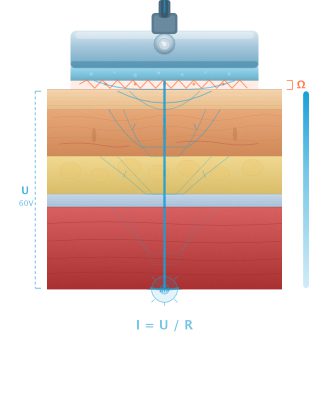
Interviewee: You cannot ensure a flow of current within tissue or through tissue – in the sense that some people, as laypeople, often imagine it. I cannot cause a direct flow through a structure, be it a joint, a muscle or an organ. That is not possible; it is not feasible.
00:16:31
Interviewer: That’s not the point of it at all, is it?
00:16:35
Interviewee: No, but many people have that idea. I’ll now apply a longitudinal or transverse current through the joint and then the current will flow through it. You can make that happen, but that’s the final electric shock – I always say this in the seminars (unedited) – you have to tap into electrical potentials, then it hisses and steams, and then the person falls dead off the stool. It doesn’t work like that.
00:16:56
Interviewer: A key mechanism of action is, of course, the voltage behind it. Yet hardly anyone talks about it, or gives it any thought. Everyone talks about microcurrent, but without voltage there’s no current either – though I suppose that would take us too far afield now.
00:17:13
Interviewee: Yes, that’s going a bit too far. I always kept that in mind, and then I realised that if frequencies are such an important medium – if every tissue in the body, every structure, has its own specific natural frequency – then it must surely have some relevance if we also apply these frequencies to central structures. That was another line of thought I had: if we consider this unit – the spinal cord, the marginal cord, the brainstem and further up – as the body’s central control mechanism, as a central information channel, then it actually makes sense to integrate this into the therapy. And if we also bear in mind what a technician once said at a previous company: ‘In the end, it doesn’t matter where you apply it, because the current finds its own path in whatever way it sees fit. It always takes the path of least resistance.’ That was another aspect for me where I said, “But surely there must be a different and simpler way of doing it.”
00:18:50
Interviewee: The next important factor that was always on my mind was: how can we simplify the whole thing? Because this whole issue of optimising the electrode system has simply caused so much confusion amongst my colleagues time and again that I told myself we had to find something simple that didn’t require much thought and wasn’t complicated. Which, when we think of practices that are organised in this way, can also be easily delegated – and that’s how I ended up developing these two system set-ups. There were originally three. I quickly discarded one because it didn’t make sense. There are two set-up schemes, and I use one of them at least 80 per cent of the time – it’s that simple. I’ll describe exactly how it’s done in a moment. Another very, very significant advantage of these two protocols for therapists who work manually on the structure is that I almost always do this in parallel.
00:20:10
Interviewee: It’s quite rare for me to treat patients manually and then connect them to the LuXXaMed device. I usually do both at the same time. But that’s perfectly possible with these two systems. When I apply them, I can still treat the knee, hip, lumbar spine or neck – whatever the area – because there are no electrodes there. There are no adhesive electrodes getting in the way. For me as a physiotherapist – after all, as physiotherapists we’re essentially craftspeople; we work with our fingers and our hands – this is a very important, practical aspect. Shall I go into the details of the two protocols?
00:21:06
Interviewer: Yes, or let’s take one of the protocols. You just said you mainly use one of these two protocols. I think – at least that’s how I see it – that the key aspect of this work is that it requires practice. That’s why we run the seminars, after all. But could you give a rough outline of how you go about it – in other words, what the basic set-up is like? Let’s take an example: we’ve been using it for years with the Clinic-Master, the HD2000, the HD1000, the HD3000 and now the HD2000+. Let’s stick with the HD2000+ for now; could you just briefly explain using that as an example – not going into too much detail, just the broad outline of the procedure?
00:22:00
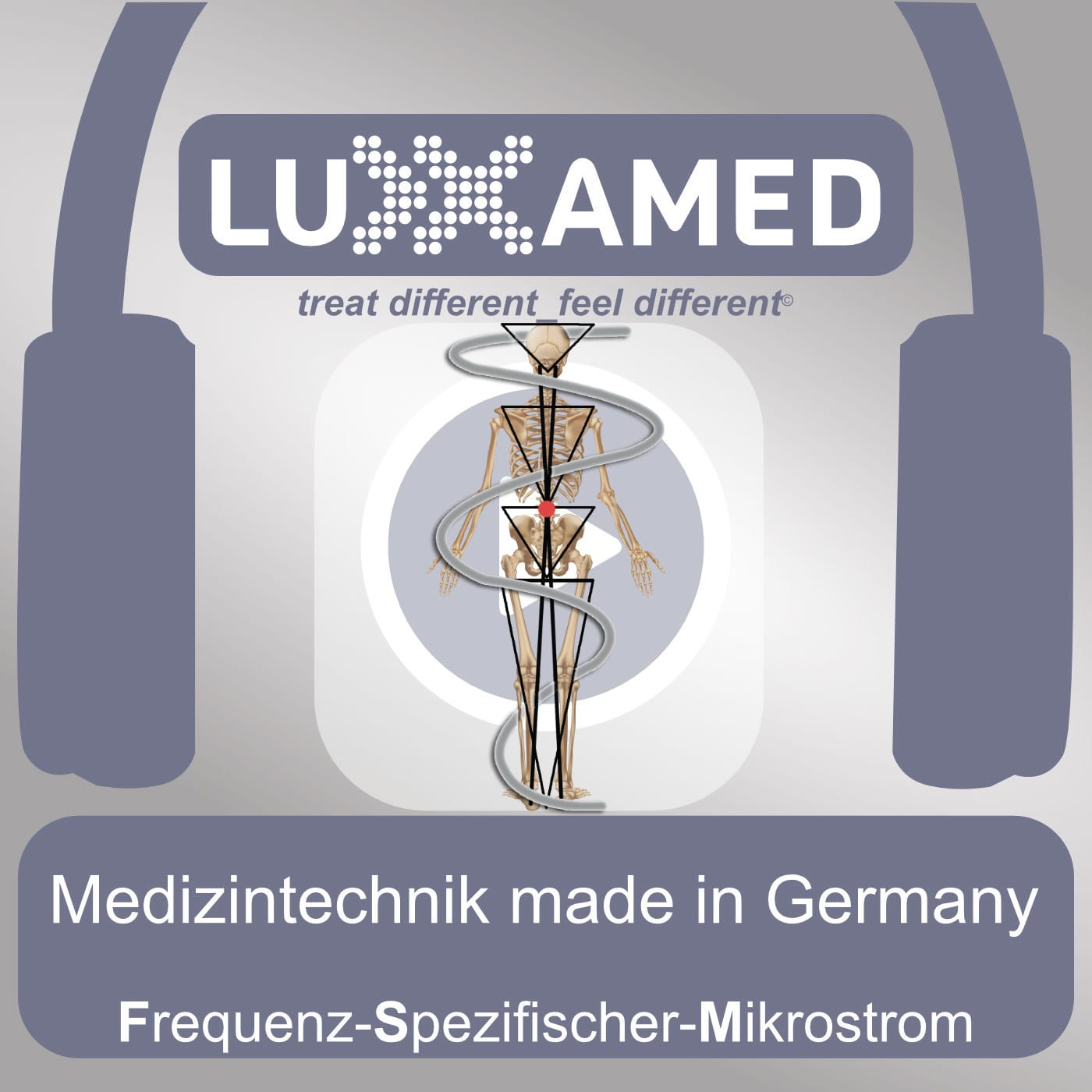
Interviewee: Very broadly speaking, this System 1 set-up is a complete system. That’s where I place the A-channel. I place the two poles of the A-channel on the feet, in the area of the outer ankles – very schematically, very (unv.) simply: A-channel, outer ankles; the B-channel on the inner ankles or on the sole of the foot. You can then adapt this to the individual, but let’s stick with this for now: the B channel. The C channel runs along the spine, that is, from the sacrum up to the nape of the neck, the hairline, or extended a little further forward to the forehead. And the fourth, the D-channel, is the ventral line, running upwards from the symphysis pubis to the clavicular fossa. That’s the diagram. That’s all.
00:23:02
Interviewer: One could now identify various approaches from this diagram. If you can be that precise at all, where do you think the primary effect lies there? Are these really 100 per cent specific points? Let’s stick to the outer side for now: the ankle joints – there are, of course, various important meridians there if you’re thinking in terms of TCM, for example – or does it relate more to the lateral muscle chains, i.e. quite classically in the field of muscle chain biomechanics? Why do you think this anlagekonzept is so effective, and what is a plausible hypothesis to explain it?
00:24:00
Interviewee: First and foremost, let me make one thing very clear: it works, full stop. In principle, I can target all the structures with it. Of course, we discussed this a lot in earlier years, or in the very, very early days I was also offered or shown diagrams: “We can place it exactly along the meridian” and so on and so forth. Or: “Here we place it exactly along the lymphatic pathway.” Structurally, schematically, I can deduce and visualise this in my mind, but I certainly can’t differentiate between them. Let’s take the inner ankles as an example – well, there’s actually more there. There are three (unv.) running upwards there. There’s a muscle chain running upwards there. There’s a fascial line running upwards there. There’s the start of the leg’s lymphatic pathway, which runs upwards: how am I supposed to know which of these structures responds most strongly to the current? I do have the option of controlling this a bit more precisely via the appropriate programme or frequency selection. I’ve already done that.
00:25:35
Interviewee: At the end of the day, though, I don’t know whether it actually reaches exactly where it’s supposed to. You simply have to state that quite clearly. You can’t differentiate it with 100 per cent certainty. You can’t say: ‘I only want to treat the meridian now.’ That won’t work, because all tissue structures are interconnected. All tissue structures communicate with one another. The frequencies provided, combined with the currents or current strengths contained in the programme, and the polarity – whether preselected or automatically determined by the device based on the measurement – are absorbed by the structures that can use them, the ones that respond to them. And those where it isn’t necessary won’t accept it. The current might simply flow past them, and that’s it. That’s one aspect. The second aspect: why does it work so well? If we take the very peripheral areas – the A-channel, the right outer ankle and the left outer ankle – the current flows between these two points. Where does it flow through then? It runs up one leg and somewhere in the pelvic region it crosses over to the other side of the body. In other words, this is a completely systemic flow of the current.
00:27:28
Interviewee: Exactly the same applies to the B-channel on the inner side. It also goes up to the (unint.), that is, the pelvis, and down to the other side. For me, that’s the systemic aspect of it, where I address precisely these structures I described earlier – lymphatic pathways, meridians, chains, muscle chains, fasciae and so on – where I simply address them within the system, within the entire network, and then the two systems, the lines – the dorsal and the (ventral?) line – one centrally (unv.) on the torso. For me, this is also a key form of regulation achieved through the application of electrical currents. For all imbalances will, in one way or another, be found or manifest along the spine, or conversely be regulated from there again, since the entire switching or control process takes place in the spine, in the spinal cord, in the medulla oblongata. That, for me, is the systemic aspect of it. And for me, that’s also the explanation of why it works – because it does work. People then often ask me: ‘Right, but if I’m operating on a knee – something very acute – how is that supposed to work? Does it work?’ Yes, it works.
00:29:01
Interviewee: The only symptomatic application I use in addition to that is the light bodies. In that case, they’re applied to the knee. I place them there on the spot. For me, that’s the symptomatic, local approach, which works perfectly for me. That’s the beauty of this application method. It’s straightforward and simple. I then have full access to all the other structures I need to treat. There are no adhesive electrodes or anything else getting in the way. I find that extremely practical.
00:29:38
Interviewer: I’m also familiar with the astonished faces and the disbelief at the seminars – which I mostly experience as an outside observer. Then the questions really do come up: ‘Well, how? Is that all there is to it? No hocus-pocus, no little powders here, no (unint.) there?” And that’s the simple part of it. And I think it’s the simplicity that makes it complicated again. I think many people are simply used to thinking in such incredibly complex terms.
00:30:14
Interviewee: Yes, we therapists do tend to get in our own way. To some extent, that’s part of the mechanism. The lovely and positive thing is that everything is always in flux. There are always people who set out on a journey, searching and researching, and then publish new work. That’s brilliant. And that’s how we make progress, too – we can optimise and improve more and more things and discover ever more aspects. On the other hand, however, it’s sometimes made far too complicated. After all, there are quite a few who try to stand out because they’re doing something that’s supposedly more or less brilliant and extravagant. But we sometimes make things difficult for ourselves, when in principle it’s actually quite simple to treat. The tricky bit for me is always much earlier on: figuring out what actually needs to be done here? What’s the issue in the first place, and where exactly is the problem? That’s the more complicated part for me. The actual treatment afterwards isn’t particularly complicated. It’s not rocket science.
00:31:35
Interviewee: Whether it’s application techniques or manual work with the fingers, it’s more or less not that complicated. It’s perhaps a matter of practice and experience, so that you can identify and regulate structures more easily and quickly. That’s certainly the case. But it’s not actually complicated, nor should it be. For the patients’ sake, it shouldn’t be either.
00:32:05
Interviewer: That was the second part of the interview with physiotherapist Matthias Rother on the use of LuXXaMed frequency-specific microcurrent therapy and LED light therapy, naturally in physiotherapy. I hope you enjoyed this second part of the interview. Just a reminder: this was the second part of a three-part interview. You can, of course, find the first part on our website www.luxxamed.de. It’s also available on all the usual podcast platforms such as Apple, Spotify and so on. Next week, we’ll be bringing you the third and final part of the interview. I don’t want to give too much away just yet. It’s certainly going to be another incredibly exciting instalment and, I think, a fitting finale to this truly brilliant interview. If you’ve enjoyed this podcast, or this episode in particular, please do rate us on Apple Podcasts, Spotify, Google – wherever you listen to us. Feel free to leave a few comments as well. If you have any feedback or suggestions, you’re of course welcome to contact us directly.
00:33:08
Interviewer: You’ll find all our contact details and information via the link in the show notes for this podcast episode and, of course, on our website www.luxxamed.de. If you have an idea for a topic that we might be able to discuss together in an interview, do let me know. We can do all of this over the phone as well. Such interviews can also be recorded very easily via Skype or other similar digital platforms. If you have an idea or would like to share your own story, we’d love to hear from you. Just get in touch and we’ll see how we can make it work. On that note, thank you for listening, and thank you for tuning in. Follow our channel, and follow us on social media such as Facebook, Instagram or Twitter – and, of course, on YouTube too. And with that, I’d like to say: thank you once again, and see you next week for the third and final part of the interview with Matthias. Until then, ciao.