Frequency-Specific Microcurrent
The use of specific frequencies in microcurrent therapy
You are currently viewing a placeholder content from Default. To access the actual content, click the button below. Please note that doing so will share data with third-party providers.
More InformationLuXXaMed frequency-specific microcurrent
Frequency-specific microcurrent? Is there also non-specific microcurrent, and what exactly is FSM (Frequency-Specific Microcurrent)? Microcurrent therapy cannot be compared with galvanic direct current therapy. Frequencies in the range from 0.1 Hz to 1000 Hz have been used in microcurrent therapy for many years. Over the last ten years, frequencies of 10 kHz or even up to 20 kHz have been added.
From this perspective, it can be said that there is actually no such thing as ‘non-specific’ microcurrent. So what exactly is Frequency-Specific Microcurrent? This term was coined in the USA by Dr Caroly McMakin, who gained worldwide recognition through numerous studies, books and scientific publications.
In Germany, Dr Wolfgang Bauermeister, known for his work in Trigger Osteopractics, implemented FSM in 2007 using the Clinic-Master Professional, combining frequency combinations based on tissue type and condition. ‘The body – a symphony orchestra. Body cells are made up of atoms that are in constant motion – vibration. These vibrations have a characteristic frequency for each tissue. Dr Bauermeister works with over 200 organ frequencies and 150 condition frequencies, combining these into a frequency pair. This results in thousands of possible combinations, as each organ or tissue can have a multitude of conditions.” (Bauermeister, 2009)
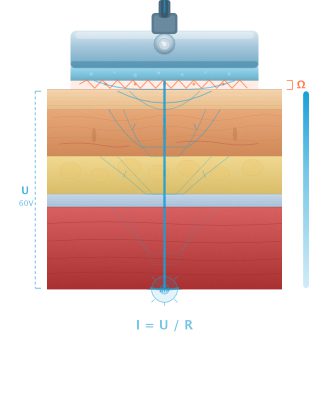
LuXXaMed therapy, on the other hand, utilises frequency bands in a cybernetic process, measuring impedance and the charging and discharging of the tissue in order to draw conclusions and carry out parameterisation and individualisation of the therapy. Specific frequencies are also employed here, but additional parameters of the microcurrent are individually adjusted and utilised.
Due to high demand from our customers in Germany, Italy and Asia, we have now implemented a software tool for the HD2000+ that enables FSM (Frequency-Specific Therapy), as described by McMakin, to be applied in its purest form. Programmes can be created quickly and easily using an Apple iPad and distributed across four galvanically isolated channels. These can be saved and edited by the user as required.
You are currently viewing a placeholder content from Default. To access the actual content, click the button below. Please note that doing so will share data with third-party providers.
More Information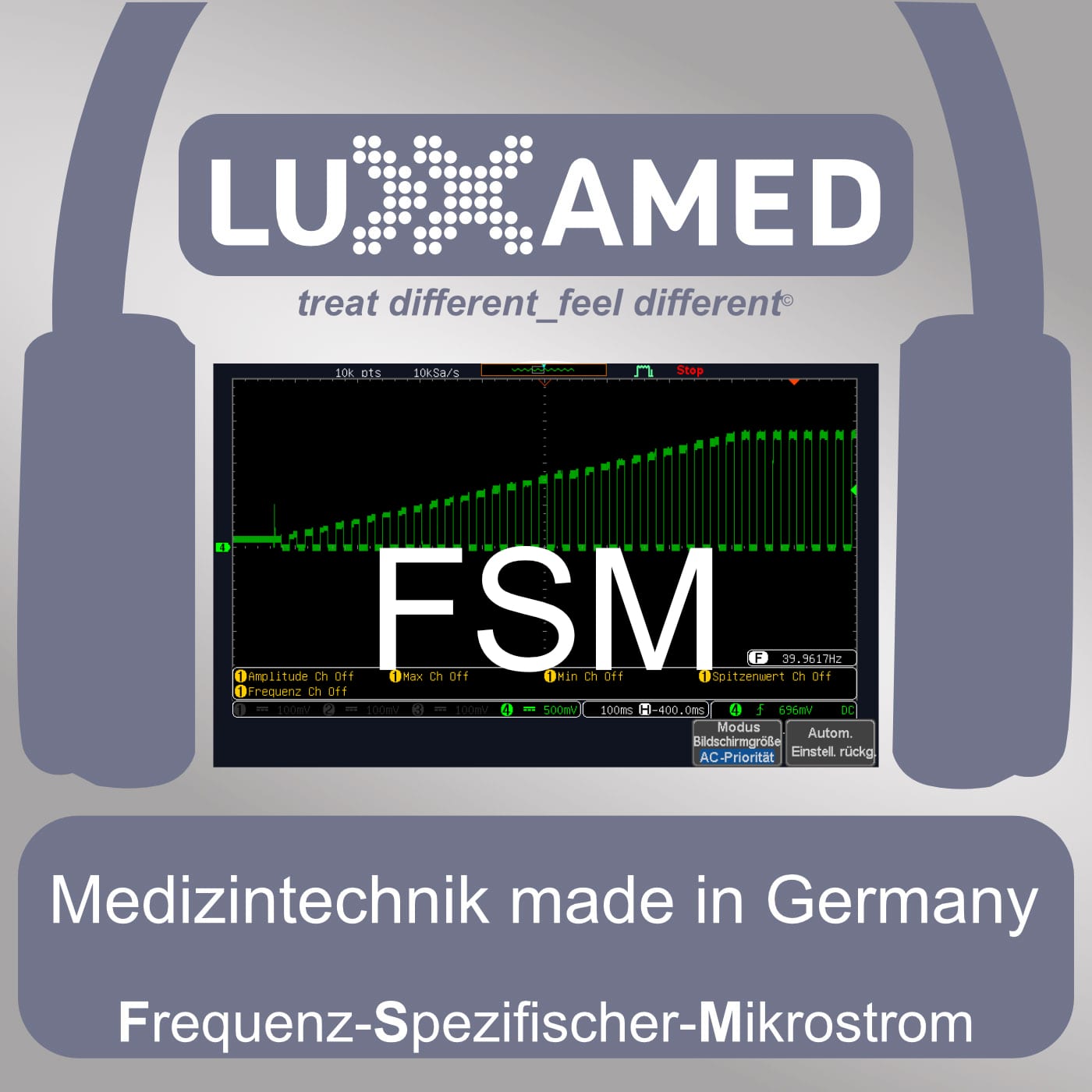
Frequency-Specific Microcurrent – Transcript of the episode
00:00:00
Introduction: Welcome to a new podcast from LuXXaMed GmbH. In this episode, I’ve brought you a new interview with Dr Thorsten Stüker, a physicist and developer of microcurrent systems and microcurrent software, and this time we’d like to discuss the topic of frequency-specific microcurrent, or FSM. Why have we chosen this topic? For two reasons, if you will: Firstly, because we have now implemented this feature in the latest version of our software for clients, therapists and doctors who wish to use this method. And secondly, because it is currently enjoying great popularity, particularly in the European market but especially in the US market, and many users simply wish to apply their individually tailored, frequency-specific programmes using a microcurrent device. And to explore this topic a little further and explain what is now possible – particularly with the LuXXaMed devices – we thought we’d take a closer look specifically at FSM, or frequency-specific microcurrent. Yes, and with that, I really don’t want to keep you in suspense any longer. I’m delighted to now present to you the interview with the physicist and developer of microcurrent systems and software, Dr Thorsten Stüker.
00:01:41
Patrick: Right then, a warm welcome to the new podcast. Our guest today, as he was once before – one, two, almost two years ago – is Thorsten Stüker. And today we’d like to talk about frequency-specific microcurrent, or FSM therapy using microcurrent. So, first of all, let me say: Hello Thorsten!
00:02:00
Thorsten Stüker: Yes, hello Patrick, and thank you for inviting me onto this podcast!
00:02:05
Patrick: That’s great. Thorsten, you’ve been working on microcurrent technology for several years now, including the actual development of hardware and software to enable the application of microcurrent devices and microcurrent therapy across a wide range of fields. So, from a technical perspective, it might be quite interesting today if we shed a bit of light on the topic of FSM therapy – frequency-specific microcurrent – and take a look at what new possibilities are currently available, which we’d then like to discuss. And yes, what are the benefits for a therapist of using this new FSM therapy – although FSM itself isn’t all that new – but let’s take a step back and explain your perspective: what does FSM – Frequency-Specific Microcurrent Therapy – mean to you?
00:02:57
Thorsten Stüker: Well, first of all: FSM therapy is indeed becoming increasingly popular. You can now find articles on FSM in many specialist journals, and yet, despite all that, there’s still a sort of veil hanging over the whole subject. Hardly anyone looks into it in enough depth to really get a proper insight behind the scenes, so to speak, even though it’s not that difficult: The available literature and the books by Carolyn McMakin from the USA are actually quite detailed and show you a great many of the possibilities and ways in which FSM therapy can be carried out. To facilitate FSM therapies, in software version 3.0 we have created a system that is very quick and intuitive to use, enabling us to apply the frequencies and their corresponding channel assignments in a very, very efficient and very, very fast manner, and we can also make frequency changes during an ongoing session without any problems. So the whole process has become very, very fast and very, very simple, because we looked at the devices on the market: what are they capable of? What functionality do they offer? And we actually said to ourselves that this wasn’t enough for our development needs. I then gave some fundamental thought to frequency-specific therapy once again. There are, in fact, two important areas that have actually been almost entirely overlooked in the development of frequency-specific therapy systems to date. And that’s why I need to explain a little: I’ve just given a brief overview of the current situation and looked ahead to the future to explain how this all came about in the first place. Initial research into frequency-specific therapies took place in Japan, Russia and the USA: There, scientists discovered that minute currents at certain – that is, specific – frequencies also produced specific effects. Minute currents means microcurrent. Microcurrent is a current that can be simply defined as: less than 1,000 microamperes and less than 60 volts. In principle, that is microcurrent if you simply want to classify it, and frequencies applied within a range of, say, one hertz to 20,000 hertz. In the early days, devices were available where you could simply set a fixed frequency and then apply it. That was, so to speak, the beginning of microcurrent therapy, and the technology was then continuously refined, leading to devices such as the LuXXaMed HD 2000 series, where you could enter frequencies directly. However, that was still relatively inconvenient and, I would say, did not meet the technical standards one would expect today. My aim was, on the one hand, for it to be easy to use, and on the other hand, for it to be intuitive, so that the user – the practitioner – can be absolutely certain, the moment they start the microcurrent session, so to speak, that this session is indeed simple and easy to operate. Of course, this would otherwise be incredibly difficult for the practitioner if they had to familiarise themselves with every detail from scratch each time, especially if the system is difficult to operate. That was exactly what we wanted to avoid. So we set to work and took a closer look at the technology. Naturally, we also had a look around: what are the competitors doing? And we realised that, in fact, there is no system that tailors microcurrent therapy to metabolic conditions. LuXXaMed has, in fact, always based its entire therapy model on the relevant metabolic conditions, and we then realised that we could also steer frequency-specific therapy in this direction. So, that’s essentially what has changed in the final version of HD Ware 3.0. HD Ware is the software platform we’re developing in collaboration with LuXXaMed, and within this platform we’ve realised what I believe is ultimately the most advanced form of microcurrent therapy in the field of frequency-specific therapy. Thanks to its quick and easy usability, we’ve achieved what others haven’t managed in this form: intuitive operation and the fastest application. This means that if, for example, you want to change frequencies, you can adjust the numbers whilst they’re being applied. Once you press Start/Update, precisely these figures – with the amended frequencies – are applied. It doesn’t matter whether you’ve entered one figure or 800 figures. That’s irrelevant. So you can use an incredibly wide range of therapies and therapy protocols. We’ve taken all of this into account and ensured that these therapy protocols are functionally intuitive, whilst presenting the whole thing with LuXXaMed’s familiar display of metabolic measurements.
00:09:08
Patrick: And at the same time, perhaps just to clarify once more. The fact is that we can also apply frequency-specific therapy here via four channels, rather than via just two channels, as was previously the case. And it’s also the case that one can tailor the metabolic aspect you mentioned – that is, the actual parameterisation of the device or the output signal – to the metabolic state. Perhaps if you could then demonstrate the practicality of this again: so we have four channels, which are, of course, completely galvanically isolated from one another – what advantage would this offer a therapist practising FSM therapy?
00:09:52
Thorsten Stüker: In FSM therapy, it’s been the case up to now that treatment was often carried out using two devices simultaneously – two such two-channel devices at the same time. On the one hand, this is very complex to operate, because ultimately you end up with two laptops on the table, and that makes the whole thing very difficult. From a regulatory perspective, the matter is much, much more complex, because it is not permitted at all to treat patients with two devices simultaneously. So that is one of the problems we were, of course, well aware of. And we also recognise, of course, that the combination of – ultimately – two pairs of state frequency and tissue frequency each naturally enables me to exert therapeutic influence at a level of precision that we simply did not have before. By also implementing the metabolic measurement, we ultimately have an overview of what is happening in the tissue. We can see very precisely what the tissue is doing at any given moment. In principle, we can also get an overview very quickly. Incidentally, this development led to our testers repeatedly asking us: ‘So, how am I supposed to set the channel now?’ We then spent quite some time mulling over how best to explain this, and amusingly, once I’d finished the explanatory model, I sat down and, within a few days, turned this model into a software programme – and then simply decided, I really didn’t fancy having to explain it over and over again, because it doesn’t help anyone – it just wastes everyone’s time – so I went on to create the so-called cybernetic microcurrent application for frequency-specific treatment. What does it do? Like our automated therapies on the LuXXaMed device, by the way, it starts with a scan. This 4-minute scan determines the metabolic conditions at the start of the treatment and automatically configures the channels. This means that my application is now once again heading precisely in the direction I need to go, namely, alongside influencing the frequency of the relevant tissues and alongside influencing the state of the relevant tissues – if one follows Dr McMakin: Dr McMakin has a very robust, very sound model for this, which she has also tested extensively; however, we are adding a further component: this additional component is the metabolic component. By regulating the channels, we can then influence the metabolic conditions accordingly, so that – and this is, after all, the aim of therapy – we can return to optimal metabolic conditions in the tissue.
00:12:59
Patrick: But perhaps also, just so there’s no misunderstanding here in the podcast: The software platform, the software version, does indeed include the classic FSM variant, in which a doctor or therapist can actually enter their own protocols, which can then simply be retrieved and are also storable in the device – so you can save your own therapy protocols in the device – and the cybernetic FSM, which you’ve just been talking about – where the device itself determines the metabolic potentials as the basis for therapy or therapeutic procedures – is an additional feature. Both options are available (unv.).
00:13:35
Thorsten Stüker: Correct. The thing is: you don’t have to use the cybernetic mode, but you can use it. I do feel that you should use it, but you don’t have to. This means you can carry out your FSM therapy as normal. Of course, you can also save the protocols; you can load them again later – there’s no question about that. And, naturally, you can in principle configure the therapy just as you’re used to, just as you’ve always done. However, you can also – and this is precisely the advantage – let the cybernetic mode take care of the parameterisation for you; it then ensures that, in addition to our two components, we simultaneously have a corresponding component that addresses the metabolic situation of the tissue. This is automated. This means that, within the therapeutic dynamics of microcurrent therapy, I see significant changes in real time – simply because I cannot click the mouse fast enough to match the speed at which the computer can make a decision – as well as in terms of precision. After all, we humans cannot see metabolic processes. We may be able to speak to the patient if necessary. We can also carry out palpation and percussion examinations whilst administering treatment. This will certainly yield one or two findings. Whether the tissue is becoming softer or harder, or whether the percussion examination reveals, shall we say, something that can be used as an assessment. But none of this tells us anything about the actual metabolic conditions. And it is precisely these metabolic conditions that are always an indicator of whether everything is fine in the tissue or whether nothing is. Right? And the big problem here is that, as a rule, nothing is right. That is to say, in a great many scans – I’ve analysed, I don’t know, several thousand scans – it is actually the case that they do not necessarily lie within the metabolic optimum, but occur in a wide variety of configurations. And in my view, it’s also the case that this very component – metabolism – has so far been overlooked in the application of frequency-specific microcurrent therapy. In other words, most people have simply said: ‘Right, I’ll always set all channels to bipolar.’ That’s a comment I’ve heard, for example. And then I set my frequencies and everything’s fine. You can do it that way. But that doesn’t necessarily produce a good result. But if I say I already have measurement results – and we have them anyway, whether I’m working parametrically or non-parametrically – I always have the measurement results automatically recorded in any case. And because I have these measurement results, I was able – in principle, this is a product of our automated therapy, a product of the automated therapy system – to automate FSM therapy without any major problems. And that is precisely the point: we immediately have this ‘Metabolik’ component on board. This means that we’re adding a further, third component to the existing way of thinking about and approaching microcurrent therapy with a frequency-specific approach: alongside the tissue and the condition, we now also have the metabolic component. And this always relates to each individual current path, so I can achieve completely different metabolic results than if I were to try to set the parameters manually – as the saying goes: ‘That won’t work.’ So you never achieve the optimal result, never the optimal density that you’d have to line up in a sequence based on the decisions the system makes, because the system is, in principle, constantly monitoring the values and always deciding in real time: ‘What do I do now?’, whilst I, of course, am always looking at it myself, having to process it in my head first before I can make a decision. It’s just much slower, and as a result, we naturally also have a metabolic influence that achieves my goal in the best possible way.
00:18:13
Patrick: Perhaps to round off this conversation – we’ve been discussing FSM in general terms. We can certainly go into this in more detail in future with a podcast episode or several episodes; that would definitely be really fascinating. What I’d still like to know now, just very briefly: What is the difference between FSM therapy in general – that is, FSM and FSM cybernetics – and the Automatic Mode familiar to LuXXaMed users, which has been in use for 10 years now, albeit in a completely new variant or version?
00:18:46
Thorsten Stüker: It’s a bit like trying to compare grapes with walruses – it doesn’t really work. So what is the difference? Let’s start with the parameterisation: In the cybernetic FSM mode, we start with a 4-minute scan to measure the metabolic conditions. We have that in the automatic therapies as well, but the automatic therapies then do something completely different: The automatic therapies have a whole range of different treatment frequencies pre-programmed, and these frequencies are applied by the system and measured during the first three minutes, before being prioritised based on the tissue reactivity they generate. This is an AI-based approach that I simply cannot implement in FSM therapy. There are two reasons for this: Firstly, we have no idea how long the FSM therapist intends to apply these frequencies at this precise moment. Secondly, we do not know what they will enter next. That is a mystery which, incidentally, we cannot resolve either, because that is precisely what makes it interesting. Here, in principle, we combine the therapist’s knowledge of FSM therapy with the technology. With the automated therapies we have in the LuXXaMed system, we are essentially combining LuXXaMed’s knowledge, drawn from 20 years’ experience in microcurrent therapy – specifically, frequency-dependent microcurrent therapy; this must be made clear: The LuXXaMed automated therapies also work with specific frequencies, with specific frequency patterns, and with the new technology we have developed in the form of HD-Ware – which is, after all, our new software platform for microcurrent devices. This is what enables us to design these therapies to be so highly dynamic, and you really notice the difference: anyone who has experience, for example, with an HD 2000 plus or an HD 2000 and then uses an HD 2000 plus with HD-Ware will notice immediately: This is truly a completely different system. It’s much more agile, much more responsive and, ultimately, it can apply significantly – let’s say – more impressive frequencies. Ultimately, it works – how shall I put it? Ultimately, it works completely differently because the database we’re working with is much, much larger. Whereas, for example, back when we were developing the HD 2000 plus – we have to go back a few years now – we were still working with very different technical possibilities. Today, for example, we have Java Virtual Machines that we can use to implement AI even in a device like this. That would have been completely unthinkable five years ago, because it simply wasn’t possible back then. But today we can do that, and precisely because we can – that is, because the development environment allows us far, far more technological applications – I have, of course, taken the liberty of extracting far, far more from the data we collect anyway, and then, naturally, of modifying our data collection methods as well. This means that we have the ability, for example during a therapy session – something that wasn’t possible in this form before – to measure: ‘What is the impedance at frequency A, frequency B, frequency C, frequency D, frequency E?’, and if we repeat this a few times in succession: ‘How does the frequency change in relation to the transition from A to B, or from B to A, or from C to A, or from D to E?’ And these corresponding, constantly intersecting rates of change, because the impedance does, after all, adapt. That means it always takes a little while. You can then observe this, and during this adjustment period the impedance changes slightly. Until, at some point, it settles at – let’s call it the steady-state value – for the time being, although the term ‘steady-state value’ is almost the wrong one for this; but if we now take 5 seconds as ‘fast’ and 10 seconds as ‘steady-state’, then that’s where we’d be, for example. Then, of course, you have relatively extensive datasets, and if you also know how to analyse them, if you consult biophysics and engage with it very intensively, then you can figure it out relatively quickly. I won’t give too much away, so I won’t go into too much detail. This gives us the opportunity to tailor the therapy to the tissue’s reactivity, and that is a groundbreaking development: we’ve never been able to do this in this way before, because we simply didn’t have the computing power available to do so. Now we have the computing power and we have the technology for it – that is to say, we have the software technology capable of doing this. And, in principle, we have – this might sound a bit odd – a big data technology behind it for data analysis. So, in principle, we’ve utilised what’s used for analysis in the big data sector and developed our algorithms on this basis, and found that we can handle an incredible amount of data with an incredibly small amount of computing power. That’s just how it is when you’ve been optimising a programming language for this purpose for years – as is the case with Java, for example – and we’re successfully using Java in the new software. These are things that have changed, so to speak, from the starting point compared to the previous stage of development; and development is, of course, a dynamic process – a dynamic development process naturally gives you the opportunity to say: “Right, I’ve discovered something here. I’ll have a look at that!” And we now had that freedom because we developed very independently and weren’t under the pressure of having to release new software straight away, but actually developed under the premise: “We want to create a new technology. We want to use the technology we have now as a wealth of experience and build on it to create a new technical foundation for future microcurrent treatment.” And I think we’ve managed that quite well.
00:25:35
Patrick: Yes, definitely, yes. Perfect. So I think this gives listeners an overview of what’s happened, the current situation, and also the background to frequency-specific microcurrent in particular, as it’s been getting a bit of a hype on social media. But to shed a bit of light on the technological, physical and biophysical aspects, I think this conversation was really good. Thank you for your time and for your excellent insights.
00:26:05
Thorsten Stüker: It’s always a pleasure.
00:26:07
Patrick: Yes, we should definitely do another episode at some point, perhaps on a new topic or a related one. Perhaps one or two of our listeners might have an idea or a question on this that we’d be happy to answer on the podcast. That would certainly be quite cool, and with that I’d like to say: Thank you, Thorsten, for your time, and see you next time!
00:26:29
Thorsten Stüker: Bye!
00:26:31
Closing: That was the podcast. The interview with physicist Dr Thorsten Stüker on the topic of frequency-specific microcurrent in the new LuXXaMed devices and in the LuXXaMed software. I hope you enjoyed this interview, and we’ll certainly be providing further information specifically on the topic of FSM – particularly for those who are interested – in our internal training area too; by the way, I’d just like to point that out to you: At www.luxxamed.de, there is an internal training area for all LuXXaMed and Klinikmaster users, where we regularly publish new training materials, as we have done this week, namely a recording of a very, very fascinating webinar with the alternative practitioner Burkhard Hock, who is, of course, well known for the Hock pain therapy method. So: all users should do have a look there; and, of course, we’ll be publishing plenty more information, training courses, videos, white papers, e-books and so on in the near future, including on the topic of FSM – frequency-specific microcurrent. With that in mind, I’d like to say: Thank you very much for tuning in to listen to this podcast. As usual, a reminder: please rate us and subscribe to us on the platforms where you listen to us. And with that, I’d like to say: thank you very, very much for tuning in, and I wish you all the best – stay healthy! See you next week!
You might also find this interesting!
https://www.luxxamed.de/2020/11/12/fsm-frequenz-spezifischer-mikrostrom/
The year 2020 from the perspective of microcurrent therapy