Microcurrent Discussions – Interview with orthopaedic surgeon Dr Voracek, MD
Concepts and experiences with microcurrent therapy for orthopaedic conditions
You are currently viewing a placeholder content from Default. To access the actual content, click the button below. Please note that doing so will share data with third-party providers.
More InformationDr Vlastimil Voracek, MD, is a practising orthopaedic surgeon in Memmingen and has been successfully using microcurrent on his patients for over 20 years.
“I am an orthopaedic surgeon, have been working with microcurrent for over 20 years and, to be honest, can no longer imagine treating an orthopaedic patient without microcurrent. Every condition, clinical picture or problem is always underpinned by a metabolic response in the tissue. This metabolic problem is precisely the point of entry where I apply microcurrent, because I have created a different point of access to the tissue, and this approach simply works 99 per cent of the time” (Voracek, 2020)
In this episode (this podcast consists of three parts; this is part one of three), Dr Voracek explains the concept behind the effects of microcurrent in orthopaedic conditions. He describes the specific role that metabolism plays in microcurrent therapy and outlines his practical approach when treating patients.

You are currently viewing a placeholder content from Default. To access the actual content, click the button below. Please note that doing so will share data with third-party providers.
More Information Transcript – Interview with Dr Voracek on microcurrent therapy
00:00:00
Patrick Walitschek: Welcome to a new podcast episode from LuXXaMed GmbH. My name is Patrick Walitschek, and this week, as I promised last week, I’ve brought you another interview. This time, it’s another very, very fascinating interview with Dr Voracek, a long-standing practitioner of microcurrent therapy, doctor and orthopaedic surgeon.
00:00:20
Patrick Walitschek: We’ve simply called this episode ‘Microcurrent Conversations’, because we were just having a bit of a chat about his approach to microcurrent therapy for orthopaedic conditions and orthopaedic patients. But we also discussed his research work, which he has been carrying out for many years using microcurrent – and in which he is, in effect, a co-developer of the LuXXaMed devices, particularly when it comes to the medical application of these devices. He can draw on a vast wealth of experience accumulated over the last 20 years, having worked on many prototypes, tested them, and then summarised the whole thing within a context and an explanatory model.
00:01:08
Patrick Walitschek: The studies – and indeed his own experiences – prove him absolutely right in this regard; his interpretation is definitely on the right track. But I don’t want to keep you in suspense any longer. Incidentally, this interview is divided into three parts, so you’ll get a new part every week. This is the first part of the series ‘Microcurrent Conversations’ with the doctor and orthopaedic surgeon Dr Voracek.
00:01:49
Patrick Walitschek: As the title of this episode suggests, this is another interview – though actually more of an open conversation: ‘Microcurrent and Conversations’ is the title of this episode, and I’m delighted to welcome him here – or rather, he’s delighted to welcome me to his practice: Dr Voracek, an orthopaedic surgeon in Memmingen who has been practising microcurrent therapy for many, many years, as well as being a lecturer, trainer, teacher and so on. But I think he can explain that himself and introduce himself in this context.
00:02:26
Dr Voracek: Right then, Patrick, I’m delighted that we’ve been able to sit down together today and have a bit of a chat about microcurrent.
00:02:37
Dr Voracek: I’m an orthopaedic surgeon. I’ve been working with microcurrent for over 20 years – in fact, I’ve helped to develop it further and created algorithms for microcurrent applications – so microcurrent has been part of my therapeutic and diagnostic practice for 20 years. It’s part of my daily practice, and to be honest, I can hardly imagine treating an orthopaedic patient without microcurrent these days.
00:03:14
Patrick Walitschek: I’d completely forgotten that. That’s right: you’re not just a practitioner, teacher and trainer, but also, in a sense, a co-developer. In fact, it’s actually your main focus in the field of cybernetics. That’s also a term you coined: cybernetics in microcurrent therapy. When did we start with that? Was it around 2009 or 2010?
00:03:32
Dr Voracek: We started working with microcurrent in 2000, and we’d already begun with the development of the Clinic-Master. Even back then, there were already these initial approaches and the development of these new algorithms for how it should work.
00:03:51
Dr Voracek: Technically, however, there was something standing in the way, because these were, of course, only the initial approaches: how the device could, more or less, think for itself; how it could diagnose on its own; and on what basis – which measurements – conclusions would be drawn.
00:04:13
Patrick Walitschek: Yes, we already had that in the prototypes back then – if I recall correctly, with the Clinic-Master – and the final, production-ready market launch was, of course, the HD1000.
00:04:23
Dr Voracek: Exactly. Back then, I had my own special version of the Clinic-Master – I’ve actually still got it today. It was connected to my computer, and that’s where, ultimately, all these measurements were taken; from them I drew some basic insights, which more or less formed the basis for the automatic programme.
00:04:52
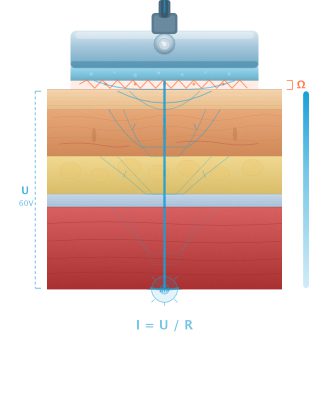
Patrick Walitschek: Yes. Before we delve any deeper into this – including the area of frequency-specific microcurrent, cybernetics and your approach to the measurements – for those unfamiliar with the device and the procedure, the measurements involve impedance measurement. It’s about the behaviour of the tissue based on electrical impedance. Based on this, certain parameters are set within the tissue or in the therapy device. But what I’d be interested to know is, roughly how many measurements have you taken since we started?
00:05:29
Dr Voracek: I don’t know. Well, there are several thick folders.
00:05:32
Patrick Walitschek: A4 folders?
00:05:32
Dr Voracek: A4 folders containing the measurements I’ve taken. But I think there are hundreds of thousands of measurements on which the whole thing is based. To put it simply, there are certainly around 20–30,000 measurements in a folder like that, and I have several folders. But a lot of the data hasn’t been printed out; it’s still on the computer’s hard drives – I didn’t print it out at the time, but saved it there instead. Because there were reams and reams of paper that had to be printed out. But I’d had enough of it by the time I’d taken, let’s say, about 20,000 measurements – enough to get a general idea of which correlations more or less exist.
00:06:30
Patrick Walitschek: Yes, yes. That’s the important foundation, after all. We’ve been trying to push that through for a long time. I mean, do you remember the study in Dresden in (unint.)? It’s not just a matter of carrying out studies from a technical perspective and, of course, a medical one. We naturally need the scientific perspective as well. These days even more so than in the past, due to the legal requirements we simply have to meet. Measurements and our own research are, of course, extremely important in this regard. But let’s take a step back for a moment.
00:06:58
Patrick Walitschek: Let’s start like this: how do you assess the development of microcurrent therapy, as you first encountered it back in 2000? From a technical perspective as well. Just in very general terms. What do you think the evolution curve has been like? How would you describe it?
00:07:20
Dr Voracek: Well, the evolution has certainly been very, very, very dramatic. Within, let’s say, five years – by 2005 – we already had a pretty good idea of what things were supposed to look like. We’d already realised how to interpret the clinical picture in relation to certain curves. Or, conversely, how the curves reveal a particular clinical picture to us. Yes, that happened relatively quickly. Then, of course, with the new equipment, we were able to take much more precise measurements. We were able to plot the curves much more accurately.
00:08:07
Dr Voracek: We also simply received a great deal more information. This information naturally accelerated the whole process. It didn’t make it any easier, but it did speed it up. In the sense that we then very quickly realised how the control systems and processes needed to be improved, or rather, what was relevant to us and what wasn’t so relevant. That’s why the evolution took place in the first 10 years, because that’s when all the theoretical foundations – or 90 per cent of them – were laid. After that, it was a matter of putting this know-how into practice in the technical realm. It was a very long journey, because there were thousands of possibilities and I had no idea about any of them. Naturally, that had to be done by people who knew what they were doing. But it was also important that those people understood what we wanted, and how the specifications we’d set were to be implemented in line with our wishes. Naturally, they had to do that, but we couldn’t control it.
00:09:24
Patrick Walitschek: Yes, difficult, of course. Let me put it this way: it’s a bit like two different worlds: on the one hand, we have the medical world, and on the other, the technical world, where you have to work out how to link the two sensibly – perhaps even using some form of AI, or artificial intelligence? And then there’s a third aspect as well: how do you get it conformity-assessed for the market – in other words, CE-marked and approved? That’s the next step that follows on from that.
00:09:55
Dr Voracek: I’d like to add something here: back then, in the first ten years, we learnt how cybernetics works, how this feedback system influences itself and so on. The next stage of development – I think from 2010 or even a little later – was when we gradually began to delve into quantum mechanics, quantum mathematics or quantum physics, where we then began to learn how to reinterpret these curves we’d obtained from these cybernetic measurements, or rather to realise that, ultimately, there was a great deal we hadn’t yet seen or recognised, and that this was only now becoming increasingly possible.
00:10:41
Patrick Walitschek: Yes, absolutely. Of course, this is where the technical aspect – or rather the physical aspect – comes into play even more strongly.
00:10:49
Dr Voracek: That’s right.
00:10:49
Patrick Walitschek: But let’s go back a bit, because I think this is something that interests many listeners and users: what’s your typical, day-to-day approach to microcurrent and LED light – which is now part of the treatment – in practice? So, in very basic terms: a patient comes to see you – how do you know that you should use LuXXaMed microcurrent in that case? That’s perhaps the first, most crucial question: what are the parameters for you?
00:11:18
Dr Voracek: Well, you basically have to be clear about several things from the outset. As I work as an orthopaedic surgeon, I naturally have to interpret it in that way.
00:11:33
Dr Voracek: There are structural problems – that is, anatomical problems. There are functional problems – that is, motor and neuromotor problems. There are hormonal influences. There are metabolic influences. But every condition, clinical picture or problem is always underpinned by a metabolic response in the tissue. In other words, if I sprain my ankle, there’s a reaction in the tissue and I’m left with scar tissue. That is also a reaction in the tissue, but I know that there are certain standard metabolic ranges within which the tissue functions, and when it becomes diseased – regardless of the cause – it exceeds these limits, either upwards or downwards: Either the metabolism increases in some way, or it is suppressed. Of course, this is then linked to a few other factors.
00:12:37
Dr Voracek: But basically, when someone comes to see me – in orthopaedics we treat a great many knee joints; we deal with osteoarthritis, we have sprains, injuries, we have back problems – then we have to realise one thing, or at least I’m always clear about this: that every problem is accompanied by a metabolic issue.
00:12:58
Dr Voracek: This metabolic issue is precisely the starting point where I use microcurrent and try to intervene there instead of – let’s say – an injection or medication, and – let’s say – stabilise the metabolism or bring it back into a physiological range.
00:13:20
Dr Voracek: We also know that changes in tissue pH trigger pain; that is to say, when it comes to pain today: many people treat pain, and pain therapy is carried out. But what is actually being done?
00:13:39
Dr Voracek: Pain management is carried out at the conduction level, but hardly anyone addresses the very place where the pain originates. Pain originates in the cells, deep within the tissue, and ultimately – when we treat pain – we must treat it at the root cause, at the source. I don’t do that with conventional pain management.
00:14:03
Dr Voracek: That’s why, when someone comes to me with pain in their knee joint… I examine the patient, I find that they may have a slight case of osteoarthritis, and then it becomes clear that the osteoarthritis may not be the problem at all, but rather the altered motor function – the adaptive motor function – that has developed. Or it might be a brief episode of overuse that has led to irritation in the knee, but this is all a metabolic response – it’s not yet a structural response. I need to intervene there via the metabolism using microcurrent wherever possible, and this is possible in 95 per cent of cases. That’s why, more or less, almost every patient now receives this form of treatment. Other orthopaedic surgeons or colleagues simply give an injection or prescribe medication to the patient – I do that too, of course, but probably far less often than my colleagues, because ultimately I’ve developed a different approach to the tissue, and this approach simply works 99 per cent of the time.
00:15:24
Patrick Walitschek: 99 per cent, OK. That’s an extremely good success rate, I’d say.
00:15:29
Dr Voracek: Yes, perhaps it’s 98 per cent.
00:15:30
Patrick Walitschek: Yeah, yeah, over 90 per cent (unclear).
00:15:34
Dr Voracek: Well over 90 per cent. Well, I mean, I’ve obviously got many years’ experience by now, so I can assess which therapy to use at what point and at what stage. And microcurrent therapy is certainly one of the first-line treatments – or at the very latest, a second-line option – and I tend to use it relatively early on.
00:16:03
Patrick Walitschek: That was the first part of ‘Microcurrent Conversations’ with the doctor and orthopaedic surgeon Dr Voracek. I hope you enjoyed this episode and that it has given you even deeper and broader insights into what the evolution of microcurrent therapy actually entails, and how far the research and ideas in this field have actually come over the last 20 years, so to speak.
00:16:30
Patrick Walitschek: If you’ve enjoyed this podcast, please rate us on iTunes. Subscribe to our podcast on whichever platform you usually listen to us on – be it on YouTube, even if only a small still image is displayed there, or on Apple Podcasts, on Spotify, wherever you listen to us: subscribe to us and rate us. If you have any questions or feedback, just drop us a line. You’ll find all our contact details at www.luxxamed.de, and with that I’d like to say goodbye for now – see you next week for the second part of ‘Microcurrent Conversations’. Thank you very much and see you soon!